
Astronomical Telescope STEM Lab
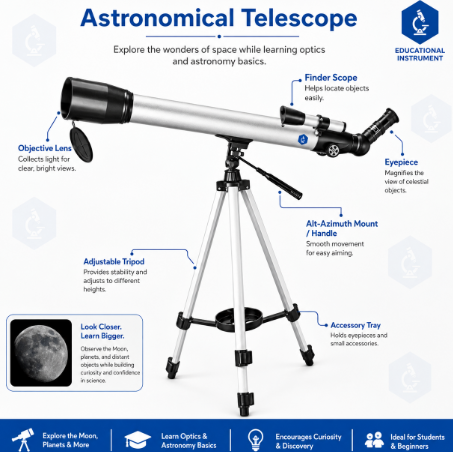
Product Code : SCL-OS-12570
The Astronomical Telescope STEM Lab Apparatus by Educational Instrument India is a premier, demonstration-grade optical instrument engineered to bring the principles of astrophysics and geometric optics into sharp focus. Specifically developed for STEM academies, school physics laboratories, and higher education institutions, this apparatus breaks down the complex internal workings of a refracting telescope into an accessible, interactive, and highly educational experience.
Unlike consumer telescopes enclosed in opaque tubes, this specialized STEM model features a highly functional, semi-open or transparent rail configuration (depending on the exact model choice). This unique layout allows educators to demonstrate the exact path light takes as it passes through the system. Students can directly observe, measure, and manipulate the distance between the optical elements to understand how a real Keplerian refracting telescope gathers light, magnifies distant objects, and forms an inverted image.
By engaging directly with this hands-on kit, students move past passive textbook diagrams to master the fundamentals of light refraction, focal points, image inversion, and angular magnification.
Key Learning Objectives & Curriculum Alignment:
Refraction and Lens Mechanics: Visualizes how parallel light rays pass through a convex lens and converge at the focal point.
Magnification Equations: Provides a physical platform to calculate and verify magnification using the standard optical formula:Magnification Focal Length of Objective Lens Focal Length of Eyepiece Lens
Real vs. Virtual Images: Demonstrates how the objective lens forms a real, inverted image inside the telescope tube, which is subsequently magnified by the eyepiece to create a sharp virtual image for the observer.
Product Specifications
Every optical component manufactured by Educational Instrument India undergoes strict quality control and precision polishing to reduce spherical and chromatic aberrations, ensuring crisp, repeatable measurements during laboratory practicals.
|
Parameter |
Specification Details |
|
Model Type |
Keplerian Refracting Telescope Demonstration Kit (STEM Lab Grade) |
|
Objective Lens |
Premium double-convex (biconvex) glass lens; Diameter: 50mm; Focal Length : 300mm to 500mm (optimized for classroom scale) |
|
Eyepiece Lens |
High-transmittance biconvex glass lens; Diameter: 25mm; Focal Length : 25mm to 50mm |
|
Optical Bench / Mount |
Heavy-duty, anodized aluminum or powder-coated steel rail with integrated metric scale markings (0–500mm) |
|
Lens Holders |
Adjustable, low-friction sliding mounts with lock-screws for precision focal alignment |
|
Target Assembly |
Includes a high-contrast illuminated target or micro-printed graphic slide for indoor focal testing |
|
Total Weight |
Approximately 1.5 kg (designed for high stability on standard laboratory workbenches) |
How to Use the Astronomical Telescope STEM Lab Kit
To guarantee an impactful and accurate classroom demonstration, follow this step-by-step laboratory procedure:
Bench Setup: Place the Educational Instrument India optical rail on a flat, vibration-free laboratory table. Ensure the metric scale on the rail faces the students for easy tracking.
Mounting the Optics: Insert the sliding lens holders onto the rail. Secure the large Objective Lens at one end of the bench and the smaller Eyepiece Lens near the opposing end.
Setting the Coarse Focal Distance: Mathematically estimate the required distance between the two lenses by adding their focal lengths together . Slide the lens holders until the distance on the metric rail roughly matches this calculation, then gently tighten the lock-screws.
Target Targeting: Aim the telescope rail at a distant, brightly lit object outside the classroom window (such as a tree branch or building sign), or use the micro-printed target card placed at the far end of the laboratory.
Fine-Tuning the Image: Look through the eyepiece lens. Slowly slide the eyepiece holder forward or backward along the rail until the distant object comes into sharp, crisp focus.
Data Analysis: Have students read the final distance between the lenses on the metric scale and compare it to their theoretical calculations. Instruct them to observe and note that the resulting image is magnified but completely inverted (upside down and reversed).
Frequently Asked Questions (FAQ)
Q1: Why is the image viewed through this astronomical telescope upside down?A: This is a characteristic feature of a true Keplerian astronomical telescope. The objective lens converges light rays to form a real, inverted image at its focal plane. The eyepiece lens then magnifies this inverted image without flipping it back. For astronomical viewing (stars and planets), image orientation does not matter. To make an upright terrestrial telescope, a third optical element (an erecting lens or prism) must be introduced.
Q2: Can this laboratory model be used to look at the actual night sky?A: Yes. While this apparatus is primarily optimized on an open rail system for indoor laboratory tracking and optical experiments, it can be taken outdoors on a clear night to view the Moon, craters, and bright planetary bodies like Jupiter or Saturn, assuming it is mounted on a steady tripod base.
Q3: How do we keep the glass lenses clean and scratch-free over semesters of lab use?A: Never touch the polished optical surfaces with bare fingers, as skin oils can degrade anti-reflective coatings over time. Clean the lenses using only specialized optical lens tissues and a drop of isopropyl alcohol or dedicated lens cleaning solution. Always store the lenses in their provided protective padded cases when the lab wraps up.
Q4: Is it safe for students to look through this telescope toward the outdoors?A: Yes, it is completely safe for looking at buildings, trees, and stars. However, WARNING: Teachers must strictly instruct students never to point the telescope directly at the Sun. The large objective lens acts as a powerful magnifying glass that will concentrate solar radiation instantly, causing permanent and irreversible eye damage.
.png)

.png)
.png)
.png)