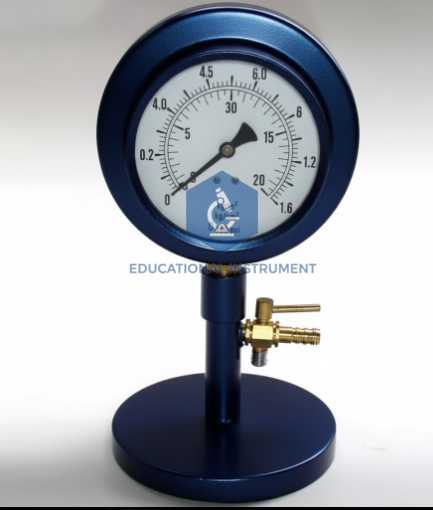
Quick Answer: The Bourdon Gauge is a demonstration pressure gauge with a C-shaped Bourdon tube, a 100 mm dial reading 0 to 4 kg/cm² and 0 to 60 psi, and a transparent rear that shows the mechanism inside. It stands on a heavy base with a vertical pillar.
Last updated: October 2026
Key Features
C-shaped Bourdon tube sensing element in elastic alloy
100 mm dial with dual scale: 0 to 4 kg/cm² and 0 to 60 psi
Transparent Perspex or polycarbonate rear to view the rack-and-pinion movement
Exposed zero adjustment and linkage
Metal inlet tubule for 8 mm ID rubber tubing
Heavy base with vertical pillar support
Technical Specifications
Specification
Value
Sensing element
C-shaped Bourdon tube, elastic alloy
Dial diameter
100 mm
Scales
0 to 4 kg/cm² and 0 to 60 psi
Movement
Stainless steel / copper alloy rack and pinion
Rear panel
Transparent Perspex / polycarbonate
Inlet
Metal tubule for 8 mm ID rubber tubing
HS code
902620
About This Product
Through the clear back, students watch the curved tube straighten slightly under pressure and turn the pointer through the rack and pinion, which explains how most dial gauges work. The gauge can be connected to gas-law apparatus to log pressure, and the twin scales give practice converting between kg/cm² and psi.
Frequently Asked Questions
What scales does the Bourdon Gauge have?
The 100 mm dial reads 0 to 4 kg/cm² on the main scale and 0 to 60 psi on the second scale.
What tubing fits the inlet?
The metal inlet tubule takes rubber tubing of 8 mm inside diameter.

.jpg)
 (1).jpg)

.jpg)
.jpeg)
.jpg)

.jpg)