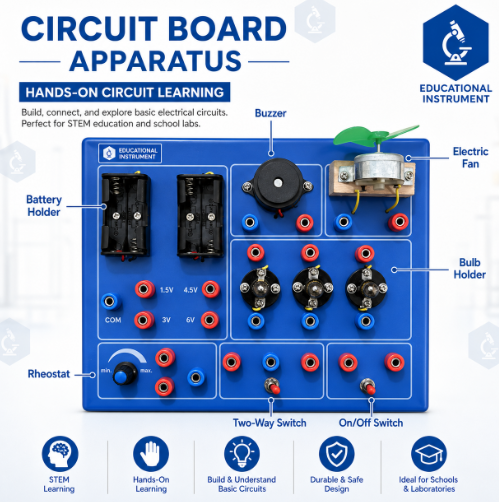
Circuit Board Apparatus STEM Lab
Product Code : SCL-EI-12553
Introduce students to the foundational principles of electrodynamics, circuit architecture, and semiconductor physics with the premium Circuit Board Apparatus STEM Lab Kit, engineered for academic excellence by Educational Instrument India. Developed to meet the strict pedagogical requirements of secondary school physics practicals, engineering foundation blocks, and advanced STEM laboratory courses, this comprehensive training platform transforms abstract electrical engineering concepts into tangible, hands-on discoveries.
Unlike standard, fragile breadboards with confusing internal connections, this lab apparatus features a rugged, high-contrast, open-chassis layout where all copper transmission paths are clearly screen-printed on a non-conductive fiberglass substrate. The station is equipped with modular, plug-and-play components including variable resistors, dual-scale analog/digital meters, knife switches, logic gate inputs, and multi-specification lamp sockets. Students can visually trace current vectors and rapidly assemble series, parallel, and series-parallel hybrid networks without the safety hazards or permanent structural issues associated with soldering or complex wire stripping.
Perfect for middle schools, industrial training institutes (ITIs), physics laboratories, and home-based STEM modules, this apparatus seamlessly moves students from textbook equations to verified experimental data. By interacting with built-in safety fuses and variable potentiometers, learners gain a deep, practical understanding of electrical resistance, voltage drops, and circuit protection systems.
Core Pedagogical and Technical Key Features:
Visible Schematics Board: Built on a military-grade, scratch-resistant FR4 board featuring high-contrast circuit symbols and pre-routed trace paths for intuitive component alignment.
Heavy-Duty Screw Terminals & Jumper Links: Heavy-duty, insulated 4mm banana jacks and spring-loaded binding posts guarantee low-resistance mechanical connections and survive thousands of student plug cycles.
Component Diversity Matrix: Outfitted with an array of real-world passive components—including fixed-value resistors, a variable potentiometer, an electrolytic capacitor, a silicon diode, and multiple light-emitting loads.
Integrated Overcurrent Safety: Incorporates an accessible, replaceable glass tube fuse block to demonstrate circuit interruption, overload safety, and short-circuit protection.
STEM Curriculum Alignment: Fully optimized for verifying Ohm’s Law, testing Kirchhoff’s Current and Voltage Laws, analyzing RC time constants, and studying diode rectification properties.
- Product Specifications
|
Parameter Matrix |
Technical Engineering Specification Details |
|
Brand Name |
Educational Instrument India |
|
Product Classification |
Basic Electronics & Applied Electromagnetism / STEM Lab Equipment |
|
Chassis Board Material |
High-grade FR4 fiberglass composite substrate with an insulated anti-static backing |
|
Terminal Connector Array |
24x Color-coded (Red/Black) 4mm shrouded banana socket terminals and nickel-plated spring posts |
|
On-Board Load Elements |
3x Miniature incandescent lamps (3.8V), 2x High-brightness LEDs with current-limiting resistors |
|
Passive Component Values |
Resistors Potentiometer (0–10 Omeg linear); Capacitor electrolytic) |
|
Control Interface |
1x Single-Pole Single-Throw (SPST) knife switch; 1x Single-Pole Double-Throw (SPDT) selector switch |
|
Power Integration Source |
Dual Input Matrix: Accepts 4x 1.5V AA battery cells or an external 0–12V regulated DC laboratory power supply |
|
Safety Mechanisms |
1x Panel-mounted 0.5A fast-blow glass fuse holder with visible status filament |
|
Assembled Dimensions |
Approx. 300 mm) |
|
Net Apparatus Weight |
Approx. 680 grams (Compact, low-profile design ideal for classroom desk storage) |
- How to Use the Circuit Board Apparatus
Ensure optimized laboratory instructional success and maximize experimental accuracy by adhering to these standard electrical engineering guidelines:
CRITICAL LABORATORY SAFETY WARNING: This apparatus is designed strictly for low-voltage, low-current DC experimentation (Max 12V DC). NEVER connect this apparatus, its jumpers, or its terminals directly to alternating current (AC) mains sockets or utility grids. Doing so risks immediate catastrophic equipment destruction and severe personal injury.
Power Configuration and Safety Inspection: Ensure the main knife switch is open (flipped up). Insert four fresh AA batteries into the integrated rear battery bay, or connect an external regulated DC power supply set to 6.0V across the primary input terminals. Verify that the 0.5A safety glass fuse is locked securely in its terminal socket.
Assembling an Ohm's Law Verification Circuit: * Connect a 4mm banana jumper cable from the positive (+) power rail terminal to the input side of the SPST knife switch.
Run a jumper cable from the output side of the switch to the input terminal of the fixed test resistor.
Connect the output terminal of the resistor back to the negative (–) ground rail terminal to close the primary circuit loop.
Integrating Diagnostic Meters:
To measure total circuit current , patch a digital or analog Ammeter directly in series into the loop before the resistor.
To measure the exact voltage drop, connect a Voltmeter in parallel directly across the two terminals of the resistor.
Data Acquisition and Analysis:
Close the knife switch to energize the board. Read and log the values displayed on the voltmeter and ammeter.
Have students verify their live readings using Ohm's Law:
Swap out the fixed resistor for the variable potentiometer. Rotate the dial smoothly to observe how changing the circuit resistance actively alters the current intensity and causes the indicator lamps to dim or brighten in real time.
- Frequently Asked Questions (FAQs)
Q1: What is the benefit of using an open printed circuit board (PCB) over a traditional solderless breadboard for student labs?
A: Traditional white breadboards have hidden, underlying vertical and horizontal copper metal clips that often confuse students who are learning to read circuit schematics. The Circuit Board Apparatus by Educational Instrument India features crisp, globally recognized schematic symbols screen-printed directly next to the actual physical components. This explicit layout helps students instantly map abstract theoretical textbook diagrams directly to their physical wire connections, reinforcing spatial and logical engineering skills.
Q2: Why do the indicator bulbs change brightness when switching from a series circuit configuration to a parallel circuit configuration?
A: In a series circuit configuration, the total resistance of the network equals the sum of all individual resistances which reduces total current flow, and the source voltage drops across each bulb sequentially. In a parallel circuit configuration, the reciprocal of the total resistance drops meaning more current flows through the circuit. Each independent branch receives the full source voltage, causing all connected bulbs to glow at maximum brightness.
Q3: What should I do if the circuit board suddenly stops working while a student is configuring a network?
A: This is usually due to a short-circuit condition that triggered the built-in safety system. If a student accidentally hooks up a low-resistance jumper path directly from the positive input to the negative ground terminal, current spikes instantly. The integrated fast-blow glass fuse opens its internal filament to protect the semiconductor components. Disconnect the power supply, fix the miswired jumper loop, unscrew the plastic cap of the fuse holder, and replace the blown fuse with a standard 20mm, 0.5A glass fuse.
Q4: Can this apparatus be used to demonstrate both Direct Current (DC) and Alternating Current (AC) properties?
A: This apparatus is optimized and structurally safety-rated for low-voltage Direct Current (DC) applications up to 12V. However, instructors can safely connect an external low-voltage AC function generator (Max 6V RMS) to demonstrate how the on-board silicon diode functions as a half-wave rectifier, allowing current to pass in only one direction.


.jpg)

.png)
.png)