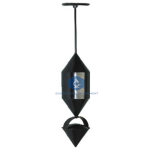
Quick Answer: The Fluid Pressure Apparatus, Hydraulic Press demonstrates Pascal’s principle with two glass cylinders of different diameters joined by flexible tubing. It has a powder-coated metal base and an approximate footprint of 250 mm x 150 mm x 300 mm.
Last updated: October 2026
Key Features
Two cylinders of different diameters for force multiplication
Transparent borosilicate or neutral glass cylinders
Flexible reinforced connecting tubing
Powder-coated metal base with footings
Approximate size 250 mm x 150 mm x 300 mm
Technical Specifications
Specification
Value
Piston configuration
Dual cylinder, different diameters
Cylinders
Borosilicate or neutral glass
Connection
Reinforced flexible tubing
Base
Powder-coated metal with footings
Dimensions
250 mm x 150 mm x 300 mm (approx.)
HS Code
9023.00
About This Product
Pressing on the narrow piston produces a larger force on the wide one, which shows that pressure applied to an enclosed liquid is passed on equally in all directions. Students compare the forces and piston areas to work out the mechanical advantage of a hydraulic press, brakes or lift.
Frequently Asked Questions
How does the Fluid Pressure Apparatus, Hydraulic Press show force multiplication?
Its two cylinders have different diameters, so a force on the smaller piston is transmitted through the liquid as a larger force on the bigger piston.


.jpg)
.jpg)
.jpg)

.jpg)