Hydraulic Press Model STEM Lab
Product Code : SCL-MH-12557
Introduce students to the engineering marvels of fluid power mechanics, pressure distribution, and mechanical advantage with the premium Hydraulic Press Model STEM Lab Kit, expertly designed by Educational Instrument India. Engineered to align perfectly with the rigorous pedagogical mandates of secondary school physics practicals, vocational training institutes, and advanced STEM curriculums, this apparatus provides a hands-on demonstration of Pascal’s Principle—showing how an incompressible fluid can multiply an input force to perform massive mechanical work.
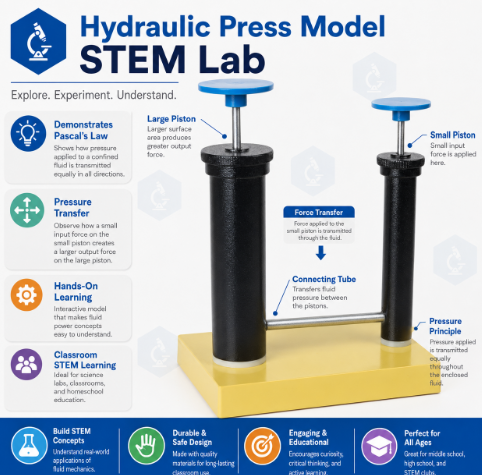
Unlike fragile, loose plastic DIY syringe configurations that flex under load or leak fluid under light pressure, this laboratory-grade model features a heavy-duty, reinforced steel or high-density acrylic load frame with an integrated dual-cylinder system. The system utilizes a smaller master cylinder (driving piston) connected via high-pressure polyurethane lines to a significantly larger slave cylinder (lifting/crushing piston). When a force is applied to the master piston, the pressure is transmitted equally throughout the contained fluid system. Because the output piston has a much larger surface area, the fluid exerts a scaled, magnified upward force capable of lifting heavy laboratory weights or crushing calibrated test samples.
Perfect for middle schools, physics labs, polytechnic institutions, and home-based engineering workshops, this apparatus shifts students from purely memorizing textbook formulas to generating empirical data. By operating the low-friction piston system and modifying the load distributions, learners can calculate mechanical advantage, observe fluid displacement limits, and gain a profound understanding of modern industrial machinery such as hydraulic brakes, automotive lifts, and heavy forge presses.
Core Pedagogical and Technical Key Features:
Rigid Anti-Flex Load Frame: Constructed from high-durability, scratch-resistant materials that isolate the load vectors, preventing structural deflection during high-pressure clamping experiments.
Dual-Cylinder Force Matrix: Outfitted with clear, medical-grade graduated cylinders possessing precise cross-sectional area ratios (e.g., 1:4 ratio) to make force multiplication visually intuitive.
Leak-Proof Barbed Fluid Ports: Features secure push-fit pneumatic fittings and heavy-wall polyurethane tubing to maintain system seal integrity even under peak manual compression thresholds.
Calibrated Removable Force Platforms: Equipped with dual graduated trays at both the input and output nodes to hold standard slotted laboratory weights for accurate quantitative analysis.
STEM Curriculum Alignment: Fully optimized for validating Pascal’s Law, analyzing work-energy trade-offs (force vs. distance), computing fluid pressure indices, and testing material structural thresholds.
- Product Specifications
|
Parameter Matrix |
Technical Engineering Specification Details |
|
Brand Name |
Educational Instrument India |
|
Product Classification |
Fluid Mechanics & Hydromechanical Systems / STEM Lab Equipment |
|
Load Frame Structural Material |
Anodized industrial aluminum support pillars with thick structural acrylic stabilization plates |
|
Master Cylinder (Input Piston) |
Clear high-purity polymer; Internal Diameter: 15 mm (Graduated metric scale) |
|
Slave Cylinder (Output Piston) |
Clear high-purity polymer; Internal Diameter: 30 mm (Graduated metric scale) |
|
Theoretical Mechanical Advantage |
Multiplier factor (Derived from the cross-sectional area ratio |
|
Fluid Transmission Conduit |
High-pressure rated, flexible 6 mm outer-diameter polyurethane tubing with quick-cinch barbed connections |
|
Safe Operational Fluid Medium |
Distilled water mixed with water-soluble food-grade dye (for high-visibility fluid ray-tracing) |
|
Maximum Load Capacity |
Structural frame rated safely for up to 15 kg (147 N) of compressive lifting resistance |
|
Assembled Dimensions |
Approx. 260 mm |
|
Net Apparatus Weight |
Approx. 850 grams (Engineered with a low center of gravity to prevent classroom desk tipping) |
- How to Use the Hydraulic Press Model
Ensure optimized laboratory instructional success and maximize experimental accuracy by adhering to these standard engineering guidelines:
CRITICAL LABORATORY SYSTEM PRIMING NOTICE: For the apparatus to perform accurately according to Pascal’s Law, the fluid loop must be completely free of air bubbles. Air is highly compressible, whereas water is incompressible. Any trapped air pockets will absorb the input energy, resulting in severe losses in mechanical efficiency and incorrect data tracking.
Fluid Priming and Air Bleeding Protocol: Fill a laboratory beaker with distilled water and add a few drops of colored food dye. Submerge the intake line, slowly cycle the master piston to draw the fluid in, and pump it through the lines until both cylinders and the connecting tube are completely filled with colored water. Ensure no air bubbles remain trapped inside the chambers before clamping the lines shut.
Demonstrating Pascal's Law and Force Multiplication:
Place the apparatus on a level laboratory table.
Place a standard 500 g slotted weight onto the platform of the larger slave cylinder.
Hand a student a smaller 200 g weight and ask them to place it onto the master cylinder platform.
Push down gently on the master piston. Observe how a significantly smaller input weight effortlessly hoists the heavier weight on the opposite side.
Quantifying the Mechanical Advantage Matrix:
Have students measure the exact linear distance the master piston travels downward versus the corresponding distance the slave piston lifts upward .
Instruct the class to verify the inverse-displacement rule and force formulas using Pascal's mathematical variables:
Confirm that while the output force is multiplied, the distance traveled decreases proportionally, illustrating the Law of Conservation of Energy where Work Input equals Work Output
- Frequently Asked Questions (FAQs)
Q1: Why does this STEM model use water as the working fluid instead of industrial hydraulic oil?
A: Real industrial hydraulic presses use high-viscosity oils because they resist breakdown under extreme heat and provide internal lubrication for heavy iron pumps. However, for a student-accessible classroom STEM kit, distilled water mixed with food coloring is chosen for safety, easy cleanup, and high visibility. Industrial oils can degrade consumer-grade polymer seals over time, are difficult to clean up if spilled by students, and pose unnecessary skin irritation hazards in a school environment.
Q2: If a hydraulic press can multiply force by four or even one hundred times, are we creating free energy?
A: No, a hydraulic press multiplies force, but it cannot multiply energy or work. According to the Law of Conservation of Energy, work input must equal work output (excluding minor losses due to friction). Because the fluid volume shifted from the smaller master cylinder is spread across the much wider area of the slave cylinder, the larger piston moves only a fraction of the distance that the smaller piston travels. You trade distance to gain force.
Q3: What causes the pistons to spring back slightly or feel "spongy" when a student pushes down?
A: A spongy response is a clear sign that air bubbles are trapped inside the fluid system. Liquids are virtually incompressible because their molecules are already tightly packed together. Gases, however, have large gaps between their molecules and compress easily under pressure. If air is trapped in the lines, your input force is wasted compressing that air pocket rather than moving the fluid columns. Re-run the fluid priming protocol to completely purge the air.
Q4: How should the Hydraulic Press Model be cleaned and maintained after a lab session ends?
A: To prevent mineral deposits, mold growth, or seal degradation between semesters, always flush out the colored water after use. Pump clean, uncolored tap water through the system twice, disconnect the polyurethane lines, and cycle the pistons back and forth to empty all internal moisture. Wipe down the load frame with a dry microfiber cloth and store the kit out of direct sunlight to protect the clear cylinders from UV yellowing.