
Parrot in Cage Model STEM Lab
Product Code : SCL-OS-12559
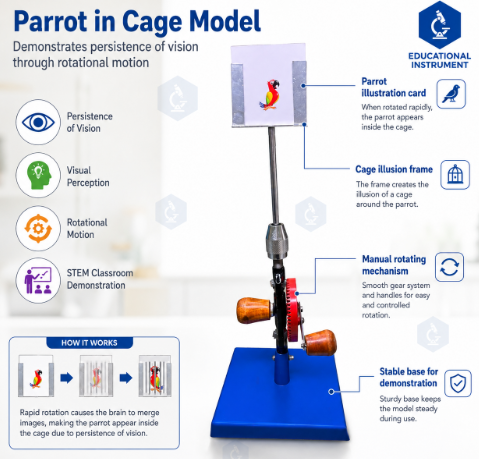
The Parrot in Cage Model STEM Lab apparatus, manufactured by Educational Instrument India, is a premium educational toolkit designed to explore the frontiers of human biological perception, cognitive science, and optical physics. Centered around the famous classical physiological discovery known as the Persistence of Vision, this apparatus provides students with an interactive, hands-on model to explore how the human eye and brain capture, process, and retain fleeting visual stimuli.
The apparatus utilizes a beautifully machined, high-velocity rotating disk mount set upon a low-vibration structural base. On one face of the optical disk is a detailed illustration of a parrot; on the exact geometric inverse face is a classic birdcage design. When stationary, the two distinct graphics are observed independently. However, when the user initiates high-speed rotation using the balanced integrated pulley-crank or precision micro-motor assembly, the two discrete optical positions fuse seamlessly into a single integrated cognitive image: a single parrot appearing directly inside the cage.
Engineered with a high emphasis on mechanical longevity and structural alignment, this STEM lab tool eliminates physical wobble, ensuring consistent optical synchronization during classroom demonstrations. By providing physical insight into sensory integration thresholds, this kit serves as an ideal pedagogical asset for secondary schools, cognitive physiology laboratories, and creative STEM centers globally.
Core STEM Learning Targets:
Biophysics of Vision: Demonstrates the chemical and neurological reaction delay times of the human retina.
Rotational Kinetics: Facilitates standard measurements linking angular frequency directly to the optical blending point.
Cinematic Framework Roots: Illustrates the fundamental scientific framework upon which modern motion pictures, animation displays, and video monitor refresh rates operate.
- Product Specifications
|
Specification Feature |
Technical Parameter Details |
|
Brand Name |
Educational Instrument India |
|
Scientific Framework |
Persistence of Vision (Retinal Visual Retention Thresholds) |
|
Drive Mechanism |
Dual Mode: Manual High-Ratio Precision Pulley Drive & Micro-DC Motor Support |
|
Disk Construction |
Ultra-lightweight, high-density balanced polymeric composite (shatterproof) |
|
Optical Graphic Material |
High-contrast, non-reflective UV matte laminated graphics (Parrot and Cage) |
|
Base Support |
Heavy-duty weighted ABS or steel alloy stabilizer base with anti-vibration padding |
|
Disk Diameter |
|
|
Bearings |
Shielded, low-friction steel ball bearings for prolonged inertia runtime |
|
Overall Dimensions |
|
|
Package Inclusions |
Main Rotating Assembly, Dual-sided Target Disks, Mechanical Drive Belt, STEM Lab Guided Workbook |
- How to Use It: Step-by-Step Laboratory Experimentation
To perform optimal classroom observations and ensure safe usage profiles, utilize the following standardized laboratory guidelines:
Step 1: System Assembly and Leveling
Unpack the Parrot in Cage STEM Lab unit and position the stabilizer base securely on a flat, vibration-free laboratory counter. Confirm that the drive belt matches perfectly across the drive wheel grooves and the target disk mount axle.
Step 2: Baseline Static Observation
Instruct students to look at the disk while completely stationary. Note that the eye clearly registers the parrot on side 'A' and the empty cage on side 'B' as separate spatial events. Measure the dimensions of the graphics using the provided lab guide metrics to calculate alignment ratios.
Step 3: Introducing Angular Acceleration
Gradually rotate the drive crank handle to initiate spinning, or engage the variable-speed motor switch. Begin at a low velocity of roughly 1 to 2 rotations per second (Hz). Students will note a distinct flickering effect where both images alternate quickly but remain unblended.
Step 4: Achieving the Optical Persistence Threshold
Slowly increase the rotational speed. Once the disk reaches an angular velocity corresponding to a frequency greater than 16 frame changes per second, the human eye can no longer separate the chemical signals arriving from the retina.
At this point, the neurological delay merges the images, showing the parrot trapped completely within the cage structure. Instruct students to use a laboratory digital tachometer to record the precise RPM (Rotations Per Minute) at which the flicker effect vanishes completely.
- Frequently Asked Questions (FAQ)
Q1: What is the primary physics concept demonstrated by the Parrot in Cage Model?
Ans: The model highlights the Persistence of Vision. This is a biological phenomenon where an image remains on the human retina for approximately 1/16th of a second after its source is removed. When images change faster than this processing window, the brain synthesizes them into an uninterrupted, single visual event.
Q2: Why do some students see the blended image at lower speeds than others?
Ans: Visual retention rates and light-processing pathways vary slightly based on age, eye fatigue, and ambient laboratory lighting conditions. This natural variance creates a great data plotting exercise for students to map out user fatigue curves.
Q3: How should the optical disks be cleaned or maintained?
Ans: The disks by Educational Instrument India are coated with a protective UV matte layer. Clean them simply by wiping with a dry, lint-free microfiber cloth. Do not use harsh solvents or abrasive cleaning agents, as these can dull the high-contrast graphics.
Q4: Can we use customized drawing disks with this device?
Ans: Yes. The heavy-duty universal disk hub is designed to allow custom student cards to be clipped on smoothly. This makes it highly versatile for open-ended STEM engineering projects, animation classes, and creative design experiments.

.png)
.png)