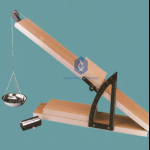
Quick Answer: The Absorbent and Emitting Powers Apparatus compares how different surfaces absorb and emit heat radiation. Students heat or cool the surfaces under similar conditions and compare their temperature rise or cooling rate.
Last updated: October 2026
Key Features
Compares heat absorption and emission by surfaces of different colour and finish
Shows that dark surfaces absorb and emit heat radiation better than polished ones
Temperature readings are taken at regular time intervals for each surface
Used for both absorption (heating) and emission (cooling) experiments
Technical Specifications
Specification
Value
Principle
Different surfaces absorb and emit heat radiation at different rates
Main concepts
Absorption, emission, radiation, surface colour, heat transfer
Experiment type
Demonstration and student practical experiment
Operation mode
Manual laboratory experiment
About This Product
Radiation is the mode of heat transfer that depends most on the surface, and this apparatus lets a class measure that effect directly. Comparing the heating and cooling rates of different finishes shows why a good absorber of heat radiation is also a good emitter. Educational Instrument can arrange export supply of the Absorbent and emitting powers apparatus to Uganda, Turkmenistan, Croatia, Serbia and Japan.
Frequently Asked Questions
Which surface heats fastest in the Absorbent and Emitting Powers Apparatus?
The dark surface. Dark surfaces are good absorbers of heat radiation, while polished surfaces are poor absorbers and also poor emitters.