Cuisenaire Strips Model STEM Lab
Product Code : SCL-MM-12454
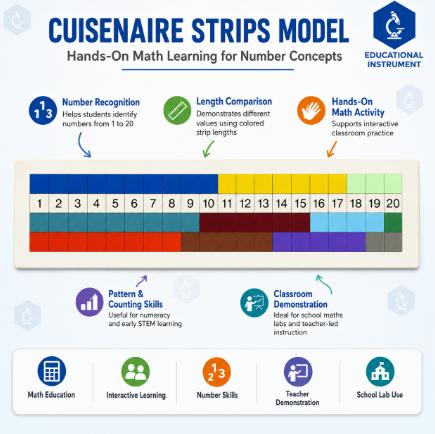
The Cuisenaire Strips Model by Educational Instrument India is a fundamental mathematical manipulative designed to help students visualize and internalize abstract numerical concepts through length and color. While traditional Cuisenaire rods are 3D, our STEM Lab Strips are precision-cut, 2D models that are ideal for tabletop exercises, desk-based learning, and interactive notebook activities.
Each set is color-coded according to the international Cuisenaire standard, allowing students to explore the relationships between numbers without the pressure of written digits. By using these strips, learners develop a deep understanding of fractions, ratios, addition, and algebraic thinking. It is a must-have for modern Math Labs and STEM classrooms focused on kinesthetic learning and the Concrete-Pictorial-Abstract (CPA) approach.
Technical Specifications
Brand: Educational Instrument India
Material: High-durability, flexible Polypropylene (PP) — waterproof, tear-resistant, and non-reflective.
Color System: Standardized 10-color system (White = 1, Red = 2, Light Green = 3, Purple = 4, Yellow = 5, Dark Green = 6, Black = 7, Brown = 8, Blue = 9, Orange = 10).
Quantity: Set of 74 strips (standard classroom ratio).
Scale: 1 unit = 1cm linear scale.
Design: Flat, 2D profile for easy stacking and surface alignment.
Safety: Non-toxic, lead-free, with precision-cut rounded edges.
How to Use the Cuisenaire Strips Model
Additive Synthesis: Place a "Red" strip (2 units) and a "Light Green" strip (3 units) end-to-end. Ask the student to find which single strip matches the total length (Yellow = 5 units).
Fraction Discovery: Place an "Orange" strip (10 units) as the "whole." Demonstrate that five "Red" strips or two "Yellow" strips equal the same length to teach \frac{1}{5} and \frac{1}{2} relationships.
Ratio & Proportion: Compare a "Dark Green" (6) to a "Light Green" (3) to visually explain a 2:1 ratio.
Algebraic Foundations: Use a strip as an "unknown" variable ($x$). If an Orange strip (10) equals a Dark Green (6) plus an unknown, the student can physically find the Purple (4) strip to solve the equation 6 + x = 10.
Frequently Asked Questions (FAQ)
Q: Why use strips instead of 3D rods?
A: Strips are more portable, cost-effective for large classrooms, and stay in place on flat surfaces, making them excellent for individual student desk work and gluing into workbooks.
Q: Is the color coding permanent?
A: Yes. Educational Instrument India uses pigment-integrated materials, meaning the color won't fade or peel even after years of heavy lab use.
Q: At what age should students start using these?
A: They are effective from ages 5 (basic counting) up to 14 (pre-algebra and complex ratios).
Q: Can these be used for decimal teaching?
A: Absolutely. By redefining the Orange strip as 1.0, the White strips become 0.1, allowing for a visual representation of decimal addition.