Dynamics and mechanical energy conservation

Product Code : SCL-MH-12614
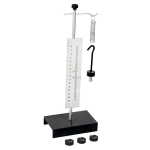
Achieve structural calibration and absolute transparency in your physics experiments with the premier Dynamics and Mechanical Energy Conservation Apparatus, exclusively engineered and manufactured by Educational Instrument India. This multi-functional mechanical training module is built specifically to bridge the analytical theories of advanced engineering mechanics with high-precision, quantifiable physics laboratory labs. Featuring hardware designed for up to 29 feasible experiments, this robust station serves as an institutional asset for university physics, civil and mechanical engineering departments, and advanced technical schools.
In modern physics, verifying how energy transitions between translation kinetic states, gravitational potential zones, and elastic fields requires minimizing external variables like chaotic friction and alignment errors. Our master suite addresses this issue through an ultra-smooth, low-friction track frame that supports multiple types of sensors. Students can systematically track reference systems, plot relative trajectories, map instantaneous velocity across one or two points, and prove that the mechanical energy sum remains completely constant within a conservative system.
The system is designed to handle both steady and variable force experiments. It comes equipped with premium, low-inertia carts, calibrated helical springs for evaluating elastic force work, and dual-mode automated photogates to measure exact velocity changes down to 0.1 milliseconds. Whether investigating what happens when an impulse is given to a cart, calculating the precise frictional deceleration vector, or mapping the kinetic and potential energy fields of a swinging gravitational or elastic pendulum, this workstation delivers pristine, mathematically repeatable data logs. Partner with Educational Instrument India to add durable, ISO-certified precision instruments to your academic curricula.
Comprehensive Experimental Capabilities (29 Feasible Laboratories):
Kinematics & Reference Frameworks: Motion relativity, reference system isolation, and trajectory plotting. Precise tracking of average speed and multi-point instantaneous velocity. Average versus instantaneous acceleration vector calculations. Achieving uniform rectilinear and uniformly accelerated motion profiles.
Forces, Inertia, & Interactions in Dynamics: Behavior analysis when no external forces act on a body (Inertia). Impulse response modeling and friction coefficient calculations. Constant force impacts vs. work done under variable forces. Mass verification and the fundamental law of dynamics (F=ma).
Work, Energy, & Conservation Laws: Quantifying work when force is non-constant (elastic compression). Isolating conservative forces vs. non-conservative dissipation. Mapping translational kinetic energy and gravitational potential values. Empirical verification of the Conservation of Mechanical Energy Principle.
Periodic Oscillations & Pendulum Systems: Analyzing periodic motions via specialized gravitational pendulums. Energy tracking across the arc of a swinging pendulum. Elastic pendulum modeling using variable hook/spring constants.
Product Specifications
Built to institutional manufacturing tolerances, this apparatus meets international academic requirements (including AICTE, ABET, and global science training regulations).
|
Hardware Specification Metric |
Detailed Engineering Parameters |
|
Brand Name |
Educational Instrument India (EII) |
|
Product Model Code |
EII-DYN-MEC-29X |
|
Linear Guide Track Length |
1.8 Meters, Heavy-Duty Extruded Satin Anodized Aluminum Base |
|
Frictional Resistance Coefficient |
μ≤0.02 (Ultra-low resistance internal wheel carriage assemblies) |
|
Time Counting Electronics |
Smart Microprocessor Photogate System with 4-digit high-brightness LED panel |
|
Timing Resolution |
0.0001 seconds (0.1 milliseconds precision) |
|
Experimental Mass Vehicles |
2x Precision balanced low-inertia dynamics carts with integrated impulse spring bumpers |
|
Mass Allocation Kit |
Calibrated interlocking chrome-plated weight blocks (10g, 20g, 50g, 100g, tolerance ±0.05%) |
|
Elastic Force Module |
3x Differentiated spring steel tension/compression modules with known linear k-ratings |
|
Pendulum Subsystem |
Rigid steel support pillar with integrated angle dial indicator and variable cord length adjustments |
|
Certifications & Marks |
CE Mark Compliant, Manufactured within ISO 9001:2015 Registered Labs |
How to Use It: Step-by-Step Laboratory Guide
The Dynamics and Mechanical Energy Conservation Apparatus is highly customizable. Below are the standard operational parameters for running core mechanics and energy verification labs:
Experiment 1: Verifying the Principle of Conservation of Mechanical Energy
Place the primary 1.8-meter anodized track on a flat, stable laboratory benchtop. Adjust the leveling feet until the built-in spirit level indicates true horizontal alignment.
Elevate one end of the track using the precise riser blocks to create a fixed, uniform incline angle (θ). Measure the starting height (h1) at the top launch point.
Set up Photogate 1 near the top of the track and Photogate 2 near the bottom. Connect both sensors to the digital micro-controller timer module.
Weigh the dynamics cart to establish its mass (M). Mount the vertical interrupting flag indicator securely onto the top frame of the cart.
Release the cart from rest from height h1. As it glides down the incline, it breaks the photogate beams, logging the transit time over each point.
Experiment 2: Analyzing the Work of an Elastic Force and Elastic Potential Energy
Set the linear guide track back to a perfectly horizontal orientation. Lock the mechanical spring anchor block securely onto one end of the track frame.
Attach one of the calibrated helical test springs to the anchor block, connecting the opposite end to the dynamics cart carriage.
Position a photogate just ahead of the cart's spring-release point to capture the maximum instantaneous velocity achieved immediately after acceleration.
Compress the test spring by a precise displacement distance (Δx) from its static equilibrium baseline, storing elastic potential energy in the system.
Release the cart. The spring converts its stored elastic potential energy into kinetic energy as it expands back to equilibrium. Record the maximum velocity via the photogate.
Calculate the kinetic energy (21Mv2) and compare it directly against the work done by the variable elastic force (21kΔx2) to verify the work-energy theorem for elastic elements.
Experiment 3: Tracking the Energy of a Swinging Gravitational Pendulum
Mount the heavy-duty vertical support rod into the anchor track socket. Attach the rigid pendulum cross-member clamp to the top of the rod.
Suspend the pendulum mass bob from the suspension clamp, adjusting the string length to a known distance (L).
Align a single photogate module so the pendulum bob passes directly through its infrared path at the lowest point of its arc (the zero potential energy reference point).
Deflect the pendulum bob to a measured initial angle (α), which raises its position to a calculable vertical height (h=L(1−cosα)).
Release the bob from rest. As it swings through the bottom of its arc, record its peak velocity using the photogate timer.
Verify that the initial gravitational potential energy matches the maximum translational kinetic energy recorded at the lowest point of the swing.
Safety, Device Calibration, and System Preservation
Friction Prevention: Periodically wipe down the aluminum track with a clean lint-free cloth and a small amount of light anti-static fluid. Dust accumulation increases friction, which can degrade data accuracy over time.
Protecting Sensors: Keep the optical sensor diodes aligned. Avoid exposing the photogates to intense, direct artificial spotlights or harsh sunlight, as this can trigger false timing readings.
Spring Care: Never stretch the calibrated springs beyond their rated maximum elastic limits. Over-extension causes permanent mechanical deformation, rendering the spring constants useless for future experiments.
Frequently Asked Questions (FAQs)
Q1: How does this apparatus accommodate all 29 feasible experiments listed in the manual?A1: This system is completely modular. By swapping or combining the included attachments—such as the low-friction track, precision carts, variable mass blocks, calibrated springs, and gravitational pendulum modules—instructors can easily shift between kinematics, force dynamics, work calculations, energy conservation, and harmonic oscillation labs.
Q2: Why is it important to measure instantaneous velocity at both one and two points?A2: Measuring at a single point lets students calculate near-instantaneous speed at a specific location along the path. Measuring across two separate points allows them to calculate acceleration vectors, track mechanical energy changes over time, and analyze the effects of non-conservative forces like friction.
Q3: Can the electronic photogate timer connect directly to a computer for automated data logging?A3: Yes. The photogate timer module from Educational Instrument India features a built-in data output port. It connects via USB to standard laboratory computers, making it easy to log data and plot energy conservation curves automatically.
Q4: What is the benefit of including both gravitational and elastic pendulums in this kit?A4: It allows students to compare different types of conservative systems. A gravitational pendulum exchanges potential energy based on gravity, whereas an elastic pendulum stores and transfers energy through spring compression and tension, demonstrating how energy conservation principles apply across different physics contexts.
Q5: What is the calibration procedure for the spring modules?A5: Calibration is straightforward. Suspend the spring vertically against the track's laser-etched scale and apply known shapes/masses in uniform increments. By plotting force against extension, students can find the precise slope to determine the spring constant (k) before starting their labs.