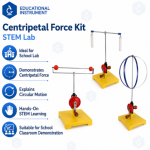
Mechanical paradox

Product Code : SCL-MH-12710
The Mechanical Paradox by Educational Instrument India is a practical physics laboratory apparatus designed to demonstrate the interesting concept of apparent motion against gravity. It is commonly used to show how a double cone appears to roll upward on an inclined pair of rails, while its centre of gravity actually moves downward.
This apparatus is ideal for school physics laboratories, college science labs, STEM classrooms, and educational training institutes. It helps students understand important mechanics concepts such as centre of gravity, stability, inclined plane motion, gravitational potential energy, equilibrium, and the difference between apparent motion and actual motion.
Key Features
Designed to demonstrate the classic mechanical paradox experiment.
Shows apparent upward rolling motion of a double cone.
Helps explain centre of gravity and gravitational motion practically.
Useful for studying stability, equilibrium, and inclined plane concepts.
Simple visual demonstration for classroom teaching and STEM learning.
Durable construction suitable for repeated laboratory use.
Ideal for school, college, and physics laboratory experiments.
Product Specifications
|
Product Name |
Mechanical Paradox |
|
Brand |
Educational Instrument India |
|
Product Type |
Physics Laboratory Mechanics Apparatus |
|
Application |
Centre of gravity, equilibrium, inclined plane, and motion demonstration |
|
Use |
Demonstrating apparent upward motion while the centre of gravity moves downward |
|
Learning Concepts |
Centre of gravity, gravitational potential energy, stability, equilibrium, motion, and mechanical paradox |
|
Main Components |
Double cone, inclined rails, support frame, and base depending on model |
|
Operation |
Manual demonstration and observation-based experiment |
|
Material |
Durable laboratory-grade metal, wood, or plastic components depending on model |
|
Suitable For |
Schools, colleges, physics laboratories, STEM labs, and training institutes |
|
Condition |
New |
How to Use Mechanical Paradox
Place the Mechanical Paradox apparatus on a flat, stable, and dry laboratory table.
Ensure that the inclined rails and support frame are properly positioned.
Place the double cone at the lower-looking end of the rails as per the demonstration setup.
Release the double cone gently without applying extra force.
Observe how the cone appears to roll upward along the rails.
Explain that although the cone appears to move upward, its centre of gravity is actually moving downward.
Repeat the demonstration and ask students to observe the position of the cone’s centre carefully.
Use the experiment to explain centre of gravity, stability, equilibrium, and apparent motion.
After use, remove the cone carefully and store the apparatus safely.
Educational Applications
The Mechanical Paradox apparatus is widely used in physics laboratories to demonstrate centre of gravity and apparent motion. It helps students understand that the motion of an object is governed by the movement of its centre of mass rather than only by its visible outer surface. This apparatus is useful for teaching mechanics, equilibrium, inclined plane motion, stability, gravitational potential energy, and scientific reasoning.
Why Choose Educational Instrument India Mechanical Paradox?
Designed for practical physics learning and classroom demonstrations.
Provides a clear visual explanation of centre of gravity.
Helps students understand mechanics through observation-based learning.
Suitable for school and college laboratory practicals.
Reliable, durable, and easy to use under teacher supervision.
Safety Instructions
Use the apparatus only under teacher or laboratory instructor supervision.
Place the apparatus on a stable surface before demonstration.
Do not push the cone forcefully on the rails.
Keep hands clear of the rolling path during the experiment.
Handle the cone and rails carefully to avoid damage.
Store all components in a clean and dry place after use.
FAQ
- What is the Mechanical Paradox apparatus used for?
The Mechanical Paradox apparatus is used to demonstrate centre of gravity, apparent upward motion, equilibrium, stability, and inclined plane concepts in physics laboratory experiments.
- Why does the cone appear to roll upward?
The cone appears to roll upward because of the shape and arrangement of the diverging rails. However, its centre of gravity actually moves downward, which explains the paradox.
- Is this apparatus suitable for school laboratories?
Yes, the Mechanical Paradox apparatus is suitable for school physics labs, college laboratories, STEM classrooms, and educational training institutes.
- Which concepts can students learn from this apparatus?
Students can learn about centre of gravity, centre of mass, equilibrium, stability, gravitational potential energy, inclined plane motion, and apparent motion.
- Is the Mechanical Paradox easy to demonstrate?
Yes, it is simple to set up and easy to demonstrate. The visual effect makes it highly effective for classroom learning and student engagement.