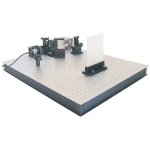
Motion

Product Code : SCL-MH-12590
Deconstruct the complexities of classical mechanics with the master-series Kinematics and Dynamics Motion Demonstration Kit, proudly developed by Educational Instrument India. Engineered specifically to address curriculum requirements for comprehensive physics lab testing, this kit acts as an ultimate experimental sandbox. It provides all necessary tools to study parameters listed under uniform, accelerated, rotational, and periodic mechanics frameworks.
From determining if a system is truly at rest or in motion to plotting high-precision linear and multi-planar pathways, this modular instrument enables students to easily visualize the physics of movement. It provides a complete laboratory array to experiment systematically with motion along a line (1D), motion on a plane (2D), and multi-axis trajectory variations in space (3D).
The kit is fully optimized to verify the fundamental laws of kinematics and dynamics—including uniform rectilinear motion laws depending on time, instantaneous speeds, the principle of inertia, acceleration, and the fundamental law of dynamics (Newton's Second Law). Additionally, students can analyze friction forces by creating an almost frictionless track setting, or isolate variables of periodic motions using our variable-mass/variable-length pendulum subsystem.
Pendulum Dynamics Analyzers: Conduct isolated tests determining how the period of a pendulum behaves depending on the amplitude of its oscillation, its structural length, and suspended mass variations.
Accelerated & Linear Systems: Measure uniform rectilinear motion, instantaneous speed steps, and uniformly accelerated motion tracking curves across time increments.
Force & Friction Interactions: Quantitatively map the action of a force on a body at rest and observe how varying the intensity of applied forces shifts system acceleration metrics.
- Product Specifications
Brand Name: Educational Instrument India
Model Reference: EII-MDK-2026 / Professional Series
Educational Level: High School, Higher Secondary (10+2), Polytechnic, and University Physics Labs
Material Composition: Low-friction Anodized Structural Aluminum Track, Stainless Steel Guide Rods, Solid Brass and Nylon Masses, Heavy-Duty Cast Base Plate
Primary Assemblies Included:
1.2-Meter Multi-Functional Precision Motion Track (with 1D/2D Scale)
Low-Friction Experimentation Cart with Weight-Loading Slots
Variable Dynamic Pendulum Assembly (with Adjustable Length Scale and Inter-changeable Masses)
Mechanical Friction Testing Block Set (Wood, Plastic, Felt surface bases)
Constant-Force Pulley system with Hooked Slotted Force Masses
Digital Photo-gate Timer Unit & High-Precision Mechanical Stopwatch
Measurement Capabilities: Linear tracking resolution down to 1mm; Time tracking down to 0.001s (via Digital Photogate)
Compliance Framework: ISO 9001:2015 Quality Systems Approved, CE Certified Pedagogy Standards
Net Package Weight: 6.20 kg (Secured in foam-padded wood-laminate or heavy plastic transport crate)
- How to Use It: Step-by-Step Laboratory Guide
Evaluating the Factors Influencing Pendulum Motion Period
Mount the variable pendulum tower onto the heavy support post of the base assembly.
Testing Length Dependencies: Adjust the cord string length to 25 cm using the integrated ruler metrics. Suspend a 50g brass mass. Pull back by a modest angle to initiate oscillation, and use the included time interval measurement tool to track the time required for 10 complete periodic motions. Divide by 10 to establish the true base period. Repeat the process at 50 cm and 100 cm to confirm how length alters the period.
Testing Mass Dependencies: Keep the length locked at 50 cm. Substitute the 50g brass ball with a 100g brass mass, and then a lightweight nylon mass. Re-run the timing intervals to prove to students that the period of a pendulum does not depend on its mass.
Testing Amplitude Dependencies: Using the same setup, launch the pendulum from an angle of 5 degrees, then repeat at 30 degrees to visually distinguish how wide amplitude adjustments affect the perfect harmonic period.
Verifying Uniform Rectilinear Motion & Uniformly Accelerated Motion
Level the aluminum track perfectly horizontally to eliminate gravitational bias, establishing an almost frictionless path.
Uniform Rectilinear Test: Give the cart a gentle push. Use the photogate sensors distributed at fixed equal distances along the path to determine the average speed and instantaneous speed across each interval. If the speed values remain constant across time, uniform rectilinear motion is verified.
Uniformly Accelerated Test: Elevate one side of the track or attach the cart to a trailing mass hanging over a constant-force end pulley. Release the cart from a position of absolute rest. Measure how the velocity progressively spikes over time intervals to illustrate acceleration curves and chart the fundamental law of dynamics.
Measuring Friction Forces and the Principle of Inertia
Position the mechanical friction testing block on the horizontal track surface.
Attach a light pulling cord from the block to a spring balance tool. Gradually pull horizontally until the block just breaks from rest into motion. Record this critical limit to map static friction thresholds.
Change the base surface of the block (from smooth wood to high-resistance felt) to analyze how surface textures impact friction coefficients. Change track alignment to showcase trajectory transitions from planar paths into free motion in space.
Frequently Asked Questions (FAQ)
Q1: What tool for measuring time intervals is included with this kinematics kit?
Ans: Each professional kit comes packed with a high-accuracy dual-channel Digital Photogate Timer with 1-millisecond sorting resolution, alongside a classical mechanical backup stopwatch. This helps schools comfortably execute modern, high-precision electronic timing or standard manual tracking workflows.
Q2: Can this kit be adjusted to demonstrate multi-dimensional trajectories like motion on a plane or in space?
Ans: Yes. While the aluminum track guides perfect linear motion along a line (1D), the kit includes an auxiliary angle-adjustable projectile launcher component. This add-on allows teachers to project spheres at varying launch vectors to accurately record motion on a plane (2D parabola) and track free flight mechanics in three-dimensional space (3D).
Q3: How does this apparatus isolate the effect of force intensity on acceleration metrics?
Ans: By utilizing the constant-force end pulley and the precise slotted weight hanger, you can change the accelerating force cleanly (e.g., swapping out 10g, 20g, or 50g weights) while maintaining a constant total cart mass system. This directly proves the fundamental law of dynamics , establishing that acceleration is directly proportional to the intensity of the driving net force.
Q4: Are specialized replacement components or additional weight assemblies available from the factory?
Ans: Yes. As a leading primary scientific developer, Educational Instrument India supports long-term educational pipelines. Educational facilities can order additional specialized sensors, standalone replacement carts, specific balance rods, or heavier slotted masses by quoting our global parts catalog indexes.