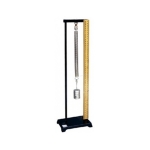
Physics of sound

Product Code : SCL-MH-12620
Bring exceptional precision and quantifiable clarity to your wave mechanics laboratory with the premier Physics of Sound Experimental Apparatus, exclusively designed and manufactured by Educational Instrument India. This multi-functional physics workstation is expertly engineered to translate the invisible, abstract dynamics of acoustic waves into highly observable, measurable physical phenomena. Optimized to cover the entire spectrum of sound characteristics required by modern science curricula, this robust system serves as an essential teaching and research asset for universities, polytechnic colleges, and advanced science programs.
In classical physics, analyzing sound requires specialized instruments that can isolate mechanical vibrations, determine true wave frequencies, and measure wave velocities while minimizing room echo or environmental interference. Our master workstation achieves this by integrating high-Q Resonance Tubes, precision-tuned Acoustic Tuning Forks mounted on wooden resonance boxes, and adjustable-frequency generation nodes. This setup lets students explore how sound travels through different materials, observe mechanical wave reflections, and map out parameters like wavelength ($\lambda$), frequency ($f$), nodes, and anti-nodes with complete repeatability.
The complete kit contains a versatile selection of high-grade acoustic modules: a laser-graduated Resonance Tube Sub-kit with water leveling tanks to determine the exact speed of sound via air-column resonance, a Sonometer Block for examining the transverse vibrations of stretched strings (Mersenne's Laws), and a sensitive microphone/piezo sensor linkage for digital/analog oscilloscope readouts. Whether you are mapping the relationship between pitch and frequency or quantifying the compression and rarefaction vectors of longitudinal waves, this workstation delivers pristine, mathematically sound data logs. Trust Educational Instrument India to provide your classrooms with durable, ISO-certified laboratory gear built for generations of rigorous academic discovery.
Complete Curriculum Coverage Capabilities (Syllabus Match):
Wave Propagation & Properties: Visualizing longitudinal wave patterns (Compression & Rarefaction boundaries). Measuring the speed of sound in ambient air and tracking thermal changes. Investigating the propagation velocity of acoustic waves through solid rods. Analyzing sound reflection, echo mechanics, and attenuation margins.
Frequency, Pitch, & Vibrating Strings: Verifying Mersenne’s Laws using the integrated mechanical Sonometer. Analyzing how tension, length, and linear mass density alter string frequency. Differentiating pitch from physical frequency and tracing pure harmonic overtones.
Resonance & Air Columns: Mapping standing wave matrices inside open and closed cylindrical paths. Locating absolute displacement nodes and anti-nodes inside a tube. Demonstrating sympathetic vibrations and acoustic resonance coupling.
Electronic Signal Capture & Analysis: Converting acoustic pressure waves into clean electronic waveforms. Analyzing amplitude parameters, loudness, and complex sound profiles. Demonstrating constructive and destructive acoustic interference (Beats).
Product Specifications
Built to precise institutional manufacturing parameters, this system adheres to strict engineering guidelines to provide clean acoustic tracking paths without structural data distortion.
|
Hardware Specification Feature |
Detailed Technical & Material Parameters |
|
Brand Name |
Educational Instrument India (EII) |
|
Product Model Code |
EII-PHY-SND-26A |
|
Resonance Tube Component |
Clear, heavy-walled Borosilicate glass tube (1000mm length $\times$ 40mm diameter) with a continuous laser-etched metric scale |
|
Linear Scale Resolution |
0 to 1000 mm range, accurate to $\pm$0.5 mm |
|
Water Leveling Tank Manifold |
Anodized aluminum water reservoir connected via flexible, non-kinking silicone tubing with a smooth vertical slider clamp |
|
Acoustic Tuning Fork Set |
4x High-Q steel tuning forks (256Hz, 384Hz, 426Hz, 512Hz) accurately calibrated to $\pm$0.05% frequency tolerance |
|
Resonance Sound Boxes |
Premium seasoned pine-wood resonance boxes matched to specific fork frequencies for optimal acoustic amplification |
|
Sonometer Apparatus |
1-Meter pine wooden sounding bridge with metallic string-tension pegs, adjustable bridges, and a spring balance scale |
|
Sensor Monitoring Array |
High-sensitivity dynamic microphone wand and piezo transduction pads compatible with external oscilloscopes |
|
System Structural Weight |
9.2 kg (Gross dry weight packed inside an impact-resistant safety transport case) |
|
Quality Standards |
CE Mark Certified, Manufactured under strict ISO 9001:2015 Quality Protocols |
How to Use It: Step-by-Step Laboratory Guide
The Physics of Sound Experimental Apparatus can be configured quickly for multiple experiments. Below are the standard operational steps for running core air-column resonance and string vibration labs:
Experiment 1: Determining the Speed of Sound in Air via the Resonance Tube
Place the resonance tube chassis on a flat, stable laboratory benchtop. Turn the adjusting thumbscrews until the vertical tube aligns perfectly straight.
Fill the reservoir tank with distilled water. Raise and lower the tank to confirm that the water level moves smoothly along the length of the clear borosilicate tube.
Select the 512Hz tuning fork from your kit. Strike the fork prongs gently with the included rubber mallet to initiate a pure, stable acoustic vibration.
Hold the vibrating tuning fork horizontally just above the open top mouth of the resonance tube, keeping its prongs close to the lip without touching the glass.
Slowly lower the water reservoir slider, which drops the water line inside the tube and increases the length of the internal air column.
Listen closely for a sudden, dramatic spike in sound volume. This amplification indicates your first resonance position (the first anti-node). Lock the water slider and record this height off the laser scale.
Lower the water line further until you find a second sharp increase in volume, and record this position .
Calculate the experimental speed of sound using your frequency and wavelength via the wave equation.
Experiment 2: Verifying Mersenne's Laws of Transverse Vibrations using the Sonometer
Position the Sonometer block on your lab bench. String one of the steel test wires across the bridge pins, attaching the opposite end to the weight hanging assembly.
Place two adjustable wooden support bridges beneath the wire at a measured distance apart (e.g., 60 cm), isolating that specific vibrating segment length .
Place a small, folded piece of paper (a paper rider) right in the center of the isolated wire segment.
Strike a tuning fork (e.g., 256Hz) with the rubber mallet and press its solid stem firmly against the top of the wooden sonometer box frame.
Gently adjust the distance between the two support bridges. When the string segment length matches the resonance frequency of the fork, the wire will begin vibrating violently, tossing the paper rider off.
Change the tension weights and string lengths systematically to verify that a string's vibration frequency is inversely proportional to its length and directly proportional to the square root of its tension.
Device Care, Acoustic Calibration, and System Preservation
Tuning Fork Preservation: Never strike the tuning fork prongs against hard metal surfaces like concrete or steel benches. This can create micro-fractures, scuff the surface, or distort the metal, permanently changing its calibrated frequency. Only use the approved rubber mallet.
Moisture Control: Completely drain the borosilicate glass tube and reservoir tank after each lab session. Wipe the inside dry to prevent water stains, algae growth, or lime scale deposits from clouding the viewing column.
Sonometer Maintenance: Wipe the sonometer steel wires down with a light, dry cloth after use to clean away hand oils. Store the wires with a thin film of anti-rust protectant to prevent corrosion and maintain consistent linear mass density profiles.
Frequently Asked Questions (FAQs)
Q1: Why does a drop in water level cause the sound volume to spike so sharply at specific points?A1: The volume spikes because of acoustic resonance. When the length of the air column matches an odd multiple of a quarter wavelength of the tuning fork's frequency , the incoming and reflecting sound waves reinforce each other, creating a standing wave that amplifies the sound.
Q2: Can this apparatus measure how temperature shifts the speed of sound?A2: Yes. By filling the reservoir jacket with water at different temperatures (such as ice water or heated water), you alter the temperature of the air column inside the tube. This lets students measure resonance points under different thermal conditions and directly calculate the speed of sound's temperature coefficient.
Q3: What role do the seasoned wooden resonance boxes play in the tuning fork kit?A3: A tuning fork vibrating on its own moves very little air, making it quiet. Pressing the fork's stem into the pine resonance box transfers those vibrations to the box structure and the column of air trapped inside. This matching acoustic chamber projects a loud, clear tone across the classroom.
Q4: Are the acoustic sensors and microphones compatible with generic computer software?A4: Yes, versatility is key. The dynamic microphone and connection leads from Educational Instrument India utilize standard 3.5mm or BNC jacks. These plug directly into common laboratory oscilloscopes or PC-based audio analysis software for real-time waveform tracking.
Q5: How do you adjust for end-effect errors when using air resonance tubes?A5: Sound waves expand slightly past the open mouth of a tube before reflecting. To cancel out this "end effect" error, instructors can have students calculate the difference between two sequential resonance lengths ($L_2 - L_1 = \lambda/2$). This approach completely eliminates the end constant from the speed equation, delivering exceptionally accurate results.