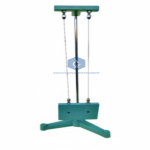
Pressure, fluids and flotation

Product Code : SCL-MH-12592
Bridge the gap between theoretical physics and clear visual observation with the premium Pressure, Fluids, and Flotation Demonstration Kit, exclusively manufactured by Educational Instrument India. Expertly structured to meet global educational standards, this comprehensive kit acts as an all-in-one laboratory suite for investigating the mechanical behaviors of liquids and gases under static equilibrium conditions.
The concept of pressure is frequently obscured by the non-precision of common language, where terms like "force" and "pressure" are wrongly used interchangeably. This kit clarifies those boundaries. By working through hands-on experiments, students learn how a force is distributed on a surface. They can directly measure the footprints and footprint depth left by varying geometric areas, visually demonstrating everyday problems such as how to walk on the snow using distributed surface areas, or why sharp objects like knives, nails, and thumbtacks can easily puncture materials with minimal effort.
Moving from solid-surface interfaces to true fluid systems, the kit provides precision apparatus to map pressure in liquids. Students can study the mechanics of how to apply a force to a liquid and how to apply a force to a gas using specialized sealed cylinders. The kit allows for quantitative analysis of when the pressure in a liquid is generated by its weight, providing a concrete verification of the specific weight properties of fluids, Stevin's law , and atmospheric pressure dynamics. Furthermore, the module contains a full suite to analyze hydro-buoyant forces, enabling students to calculate the Archimede thrust, prove the absolute principle of Archimede, and define the equilibrium parameters governing floating, sinking, and neutral submersion.
Curriculum-Aligned Sandbox: Specially built to facilitate clear, textbook-accurate practicals mapping to CBSE, NCERT, ICSE, IGCSE, and IB physics lab benchmarks.
High-Fidelity Transparency: Utilizes heavy-gauge, scratch-resistant acrylic and borosilicate glass columns to ensure full, parallax-free visual clarity of fluid lines and submersed mass behaviors.
E-A-T Quality Frameworks: Produced in an ISO 9001:2015 quality-certified facility, ensuring all overflow vessels, pressure manometers, and geometric mass sets are calibrated for precise mathematical alignment.
- Product Specifications
Brand Name: Educational Instrument India
Model Reference: EII-PFF-2026 / Master Hydrostatics Series
Target Learning Levels: Middle School, High School, Higher Secondary, and Vocational Physics Labs
Material Composition: Optical-grade Cast Acrylic, Corrosion-Proof Solid Brass, Anodized Structural Aluminum Alloys, Food-Grade Silicone Seals
Primary Assemblies Included:
Dual-Surface Footprint Sand Chamber Module (Demonstrating Pressure Distribution)
Variable-Depth Hydrostatic Liquid Pressure Column with Graduated Millimeter Scale
U-Tube Dial Liquid Manometer Assembly
Precision Overhead Lever Balance & Direct Digital Force Gauge
Classic Archimedes Overflow Vessel (Eureka Can) with Solid Geometric Displacement Cylinders
Heavy-Duty Magdeburg Hemispheres & Barometric Syringe Set (Atmospheric Pressure)
Set of Regular and Irregular Equal-Volume Floating Bodies (Wood, Aluminum, Iron, Wax)
Measurement Sensitivity: Pressure gauge tracking resolution down to 10 Pascals; Volumetric displacement accuracy down to 1 mL
Compliance Framework: ISO 9001:2015 Quality Systems Approved, CE Certified Pedagogical Layout
Total Packaged Weight: 5.65 kg (Secured in a heavy-duty, protective, shock-absorbing transport casing)
- How to Use It: Step-by-Step Laboratory Guide
Activity 1: Verifying the Concept of Pressure and Surface Distribution
Prepare the Footprint Sand Chamber Module by flattening the surface of the fine testing sand uniformly.
Take the dual-surface footprint testing block. Place it onto the sand with its wide, extended base facing downwards. Place a 500g weight on top. Remove the block carefully and measure the footprint depth using the depth probe gauge.
Invert the exact same block so that its narrow, sharp pins face downwards (simulating knives, nails, or thumbtacks). Apply the identical 500g mass on top.
Instruct students to observe the massive increase in footprint depth. This provides a clear, mathematical demonstration of how a force is distributed on a surface, proving that pressure is a new physical magnitude inversely proportional to the contacting surface area .
Activity 2: Mapping Stevin’s Law & Pressure in Liquids Generated by Weight
Fill the vertical Hydrostatic Liquid Pressure Column with distilled water. Connect the submersed flexible capsule probe to the external U-Tube Dial Liquid Manometer.
Slowly lower the pressure probe capsule vertically into the liquid column using the graduated millimeter tracking guide rail.
Instruct students to record the rising water column line or shifting needle on the manometer dial at regular 20 mm intervals. This experiment proves that when pressure in a liquid is generated by its weight, the physical magnitude rises linearly with depth, demonstrating a fundamental application of Stevin's law.
Substitute the water with a high-density saline solution or oil to analyze how fluid specific weight shifts the pressure baseline.
Activity 3: Measuring the Archimedes Thrust & Flotation Stability
Fill the Archimedes Overflow Vessel with liquid until it reaches the edge of the discharge spout. Place a small, empty, calibrated beaker underneath the spout.
Suspend an equal-volume solid iron mass cylinder from the precision hook balance gauge. Record its dry weight in air.
Slowly lower the mass cylinder into the liquid until it is completely submerged. Record the apparent weight displayed on the balance gauge .
Calculate the true Archimedes thrust (buoyant force).
Weigh the displaced volume of liquid caught in the discharge beaker. Show students that the buoyant force equals the weight of the displaced liquid, validating the absolute principle of Archimedes. Repeat the process with a lightweight wooden block to determine the exact weight criteria needed to sustain equilibrium when floating.
- Frequently Asked Questions (FAQ)
Q1: How does this kit help educators clear up the non-precision of common language surrounding pressure?
Ans: In common language, people often mix up "force" and "pressure" (e.g., saying a sharp nail exerts more force). This kit isolates force intensity from surface area using its block and sand module. Students see that while the mass force remains completely identical, changing the surface area alters the resulting pressure magnitude and structural footprint depth, establishing pressure as a unique physical metric.
Q2: Can we demonstrate how to apply a force to a gas versus a liquid using this apparatus?
Ans: Yes. The kit includes a matching pair of clear, valved syringes. When a liquid is drawn in and sealed, pressing the plunger shows almost zero displacement because liquids are highly incompressible. When a gas is trapped, the plunger compresses easily, demonstrating how forces alter molecular volumes differently across various states of fluids.
Q3: What are the two applications of Stevin’s law that can be executed with this apparatus?
Ans: The kit allows you to demonstrate: 1) The communicating vessels principle, showing that static liquids find an identical horizontal level regardless of container geometry, and 2) The hydrostatic paradox experiment, which proves that pressure at the base depends solely on depth and liquid weight profiles, not the structural shape of the container vessel.
Q4: How does the kit demonstrate the mechanics of atmospheric pressure?
Ans: The kit contains a set of precision-ground Magdeburg Hemispheres with an air-discharge valve. When the internal air is evacuated using the barometric syringe, ambient atmospheric pressure seals the halves together with immense force, showing how a heavy gas column applies pressure to every surface it contacts.