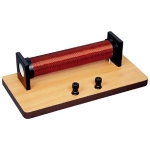
Stationary wave apparatus

Product Code : SCL-ES-12771
The Stationary Wave Apparatus by Educational Instrument India is a practical physics laboratory instrument designed to demonstrate stationary waves, also known as standing waves, in a stretched string or wire. It is widely used in school physics laboratories, college labs, STEM classrooms, and technical institutes for teaching wave motion, vibration, frequency, wavelength, tension, resonance, nodes, and antinodes.
This apparatus allows students to observe how stationary waves are formed when two waves of the same frequency and amplitude travel in opposite directions and interfere with each other. By adjusting the tension, length, or frequency of vibration, learners can clearly see different wave patterns and understand the relationship between wave speed, frequency, and wavelength.
Built for educational use, the Stationary Wave Apparatus provides a simple and visual method for explaining important wave concepts. It is suitable for classroom demonstrations, practical experiments, and hands-on physics learning.
Key Features
Designed for demonstrating stationary or standing waves
Helps students observe nodes and antinodes clearly
Useful for studying frequency, wavelength, tension, and resonance
Suitable for wave motion and vibration experiments
Can be used with string, vibrator, pulley, weights, and power supply
Easy to set up and operate under supervision
Durable construction for repeated laboratory use
Ideal for schools, colleges, STEM labs, and technical institutes
Product Specifications
|
Specification |
Details |
|
Product Name |
Stationary Wave Apparatus |
|
Brand |
Educational Instrument India |
|
Application |
Demonstration and study of stationary waves |
|
Wave Concepts |
Nodes, antinodes, wavelength, frequency, tension, resonance, wave speed |
|
Use |
Physics laboratory experiments and classroom demonstrations |
|
Suitable For |
Schools, colleges, STEM laboratories, and technical institutes |
|
Compatible Accessories |
Vibrator, string, pulley, slotted weights, stand, and power supply |
|
Operation |
Manual setup with vibration source |
|
Material |
Durable laboratory-grade components |
|
Category |
Physics Laboratory Equipment |
|
Recommended Usage |
Under teacher or laboratory instructor supervision |
How to Use Stationary Wave Apparatus
Place the apparatus on a stable laboratory table or demonstration bench.
Attach one end of the string to the vibrator or vibration source.
Pass the other end of the string over a pulley and attach suitable weights to create tension.
Connect the vibrator to the recommended power supply.
Switch on the power supply and allow the string to vibrate.
Adjust the tension, frequency, or length of the string until a clear stationary wave pattern is formed.
Observe the nodes, where the string appears still, and antinodes, where maximum vibration occurs.
Measure the distance between nodes to calculate wavelength.
Record readings and use them to study the relationship between frequency, wavelength, tension, and wave speed.
After the experiment, switch off the power supply and remove the weights safely.
Educational Importance
The Stationary Wave Apparatus is an important teaching aid for understanding wave interference and resonance. It helps students visually observe how standing waves form and how wave patterns change with tension and frequency. This makes it easier to explain theoretical concepts such as nodes, antinodes, wavelength, natural frequency, resonance, and wave speed.
By using this apparatus, students gain practical experience in observation, measurement, calculation, and scientific analysis. It supports hands-on learning and improves understanding of wave behaviour in physics.
Applications
Stationary wave demonstration
Standing wave experiment
Study of nodes and antinodes
Frequency and wavelength measurement
Resonance experiment
Wave speed calculation
String vibration study
Physics practical experiments
STEM classroom demonstrations
Safety Instructions
Use the apparatus only under teacher or laboratory supervision.
Connect the vibrator only to the recommended power supply.
Do not touch the vibrating string while the apparatus is operating.
Ensure the pulley, weights, and string are fixed securely before use.
Do not overload the string or apply excessive tension.
Switch off the power supply before making adjustments.
Store all components properly after use.
Frequently Asked Questions
- What is a Stationary Wave Apparatus used for?
A Stationary Wave Apparatus is used to demonstrate stationary waves or standing waves in a stretched string and to study nodes, antinodes, wavelength, frequency, tension, and resonance.
- Is this apparatus suitable for school laboratories?
Yes, the Stationary Wave Apparatus by Educational Instrument India is suitable for school physics labs, college laboratories, STEM classrooms, and technical institutes.
- What are nodes and antinodes?
Nodes are points on a standing wave where there is no visible movement, while antinodes are points where maximum vibration occurs.
- Can this apparatus be used to calculate wavelength?
Yes, students can measure the distance between nodes and use it to calculate the wavelength of the stationary wave.
- What accessories are required with this apparatus?
It is commonly used with a vibrator, string, pulley, slotted weights, stand, and suitable power supply.
- Does the apparatus require electricity?
The stationary wave setup generally uses a vibrator that requires a suitable electrical power supply. The exact power requirement depends on the model.
- Why is this apparatus useful for physics education?
It provides a clear visual demonstration of standing waves, making concepts such as resonance, wavelength, frequency, nodes, and antinodes easier for students to understand.