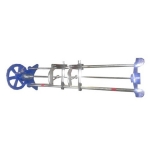
Quick Answer: The Torricelli’s Experiment Apparatus is a barometer-principle set with a glass tube held vertically on a support stand by a clamp, beside a measuring scale. A filled tube inverted into a reservoir shows atmospheric pressure supporting a liquid column, with the Torricellian vacuum above it.
Last updated: October 2026
Key Features
Glass tube fixed vertically by a clamp
Support stand in metal
Measuring scale for the height of the liquid column
Shows the Torricellian vacuum at the closed end of the tube
Technical Specifications
Specification
Value
Tube
Glass, vertical set-up
Stand
Metal support stand with clamp
Scale
For liquid column height
About This Product
After the tube is filled as the laboratory procedure directs and inverted without letting air bubbles in, the column settles and leaves an empty space above it. Measuring the column height shows that air pressure on the reservoir holds the liquid up, the same principle a barometer uses. The demonstration is run by a teacher or under laboratory supervision. Schools, colleges and institutes in Peru, Benin, Uzbekistan, Yemen, Lithuania and Australia can order the Torricelli’s experiment apparatus from Educational Instrument.
Frequently Asked Questions
What does the Torricelli’s Experiment Apparatus show?
That atmospheric pressure supports a column of liquid in an inverted tube, leaving a Torricellian vacuum above the column, which is the working principle of a barometer.