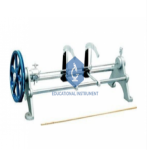
Vacuum and atmospheric pressure

Product Code : SCL-MH-12616
Bring precision validation and high-impact visual engagement to your physics laboratory with the premier Vacuum and Atmospheric Pressure Experimental Station, engineered and manufactured exclusively by Educational Instrument India. This multi-functional mechanical workstation is meticulously designed to bridge the complex, invisible theories of pneumatics, gas behavior, and hydrostatic pressure variations with quantifiable empirical evidence. Optimized to run up to this system is an invaluable foundational block for higher education, university science wings, and polytechnic engineering labs.
In classical physics, visualizing the massive structural force of atmospheric pressure and the mechanics of a vacuum can be challenging because ambient air is invisible. Our equipment solves this educational problem by putting heavy-duty, ultra-transparent vacuum chambers, low-friction hand or electronic pump adapters, and classic historical modules into students' hands. This enables clean, measurable, and highly repeatable data logging, stripping away non-ideal leaking variables and ensuring strict alignment with theoretical equations like and the ideal gas relationship profiles.
The complete setup features an exceptional assortment of modules: industrial-grade Magdeburg Hemispheres featuring premium airtight ground seals, an explicit fluid tracking Barometric Pressure Column, and an elastic compression bell-jar system. Students can quickly observe the immediate impact of atmospheric forces when air mass is evacuated from a volume, analyze acoustic wave dampening in a sound vacuum, determine the pressure drop dynamics across one or more indicators, and calculate the mechanical load air exerts at sea level. Choose Educational Instrument India to provide your classrooms with durable, ISO-certified laboratory assets built for generations of rigorous academic discovery.
Comprehensive Experimental Capabilities (18 Feasible Laboratories):
Atmospheric Pressure Fundamentals: Proving the mass and physical weight of ambient air vectors. Measuring absolute atmospheric force via localized column weights. Demonstrating multi-directional pressure equilibrium at sea level. Historical mapping via classic Magdeburg Hemispheres tests.
Vacuum Dynamics & Gas Behavior: Isolating volume expansion under non-constant external fields. Verifying partial vacuum dynamics and calculating pressure drops. Proving the correlation between boiling thresholds and surrounding pressures. Acoustic isolation: tracking the attenuation of mechanical sound waves.
Fluid Mechanics & Suction Integration: Analyzing siphon limitations under vacuum anomalies. Determining lift parameters for basic suction pump mechanics. Evaluating hydrostatic balance within closed fluid-gas manifolds.
Elasticity & Structural Expansion: Mapping the volume variations of sealed flexible elements inside a vacuum. Investigating surface area stress thresholds under high differential pressures.
Product Specifications
Built to precision manufacturing parameters, this system adheres to strict engineering guidelines to provide clean vacuum containment without data distortion.
|
Hardware Specification Metric |
Detailed Engineering Parameters |
|
Brand Name |
Educational Instrument India (EII) |
|
Product Model Code |
EII-VAC-ATM-18X |
|
Main Vacuum Chamber (Bell Jar) |
Thick-walled, optical-grade shatterproof Polycarbonate (Dimensions: 250mm Heigh 200mm Diameter) |
|
Base Plate Assembly |
Heavy-Duty non-magnetic alloy plate equipped with high-performance silicone sealing gaskets |
|
Magdeburg Hemispheres Sub-Kit |
Precision cast brass hemispheres with integrated high-vacuum release stopcocks and pull rings |
|
Pressure Indicator Gauges |
Dual-unit analog dial gauge (0 to -760 mmHg / 0 to -100 kPa) with high-contrast indicator face |
|
Vacuum Evacuation Module |
Ergonomic dual-stage manual suction cylinder (Advanced electric pump option available) |
|
Sealing Mechanisms |
High-vacuum grade chemical-inert silicone O-rings (Friction resistance optimized) |
|
System Structural Weight |
7.8 kg (Gross dry weight including protective instructional hard-case) |
|
Quality Certifications |
CE Mark Compliant, Manufactured under ISO 9001:2015 Guidelines |
How to Use It: Step-by-Step Laboratory Guide
The Vacuum and Atmospheric Pressure Apparatus can be assembled quickly for different types of tests. Below are the structural steps to perform core experiments safely and accurately:
Experiment 1: Demonstrating Atmospheric Forces via Magdeburg Hemispheres
Take the two brass Magdeburg hemispheres and clean their matching ground edges with a soft cloth. Apply a thin layer of vacuum grease to the silicone seal ring to ensure an absolute seal.
Press the two hemispheres together tightly, forcing out as much internal ambient air as possible. Align the structural pull rings opposite one another.
With the integrated stopcock valve in the open position, attach the high-tensile connection hose from the vacuum evacuation cylinder to the hemisphere nozzle.
Operate the pump handle steadily to evacuate the air volume inside the sphere. Watch the system's dial gauge sink down to the targeted negative pressure zone (-600 to -700 mmHg).
Close the stopcock valve securely to lock in the vacuum state, then disconnect the pump hose line.
Have two students grasp the pull handles and pull in opposite directions. The hemispheres cannot be separated manually because the massive, unbalanced external atmospheric pressure forces them together.
Slowly turn the stopcock valve to readmit ambient air. As internal pressure normalizes with the surrounding room, the spheres easily separate with no resistance.
Experiment 2: Tracking Volume-Pressure Expansion inside the Bell Jar Vacuum Chamber
Place the thick-walled polycarbonate vacuum bell jar over the heavy-duty base plate assembly, ensuring it sits squarely on the primary silicone perimeter gasket.
Introduce a small, partially inflated, sealed flexible rubber balloon into the center of the chamber to serve as your test object.
Connect the primary suction pump hose to the dedicated intake manifold nozzle on the base plate. Set the pressure dial to zero baseline.
Begin pumping to evacuate the internal air mass. As the dial logs a drop in pressure inside the jar, observe the balloon expanding significantly.
This clear visual expansion occurs because the air trapped inside the balloon now encounters much less opposing external pressure, illustrating the core principles of differential gas mechanics.
Open the structural relief valve to normalize air mass concentrations. Watch the balloon shrink smoothly back to its initial baseline scale.
Safety, Care, and Instrumentation Maintenance
Chamber Care: Never drop, chip, or subject the thick polycarbonate bell jar or brass hemispheres to sharp mechanical impacts. Micro-fractures can cause rapid structural collapse under high vacuum environments.
Gasket Preservation: Keep all silicone sealing elements clean and free from abrasive sand, dirt, or dust. Wipe the seals down regularly with a dry cloth and store them with a light coating of clean vacuum grease to maintain flexibility.
Valve Checks: Periodically tighten the stopcock control needles. If you notice a slow pressure leak on the dial gauge during testing, apply standard vacuum sealant grease around the threaded valve paths.
Frequently Asked Questions (FAQs)
Q1: Why are Magdeburg hemispheres used to demonstrate atmospheric pressure?A1: They provide a striking physical illustration of air pressure. When the air inside the joined spheres is evacuated, there is no internal pressure to counter the weight of the air outside. The surrounding atmospheric pressure forces them together with such incredible force that manual separation becomes virtually impossible.
Q2: Can this apparatus be used to show how a vacuum alters the boiling point of liquids?A2: Yes, absolutely. By placing a beaker of warm water (approx. 50°C to 60°C) inside the chamber and drawing a strong vacuum, you lower the surface pressure below the water's vapor pressure. This causes the water to boil vigorously at room temperature without adding any heat.
Q3: What indicates a complete vacuum on the included dual-unit analog dial gauge?A3: A perfect theoretical vacuum at sea level is indicated by a reading of -760 mmHg or -100 kPa on the gauge face. The high-performance seals included in this Educational Instrument India kit allow students to easily achieve stable levels near -700 mmHg using manual suction.
Q4: Is the polycarbonate chamber safer than traditional glass bell jars for school laboratories?A4: Yes, safety is a top priority. Educational Instrument India utilizes thick-walled, optical-grade polycarbonate because it is exceptionally impact-resistant and shatterproof. This eliminates the risk of dangerous glass implosions during classroom demonstrations.
Q5: How often do the vacuum seals require lubrication with vacuum grease?A5: Lubrication depends on usage. For best results, apply a very thin, clear film of vacuum grease to the ground edges and O-rings every 4 to 5 laboratory sessions, or whenever you detect a minor drop in vacuum pressure hold times.