Simple Pendulum Apparatus STEM Lab
Product Code : SCL-MH-12552
Introduce students to the fundamentals of mechanics and oscillatory physics with the premium Simple Pendulum Apparatus STEM Lab Kit, engineered with laboratory precision by Educational Instrument India. Built to serve as a bedrock instrument for physics laboratories, classroom science frameworks, and advanced STEM academies, this professional-grade kit offers a high-fidelity visual and structural framework to analyze properties governing simple harmonic motion (SHM).
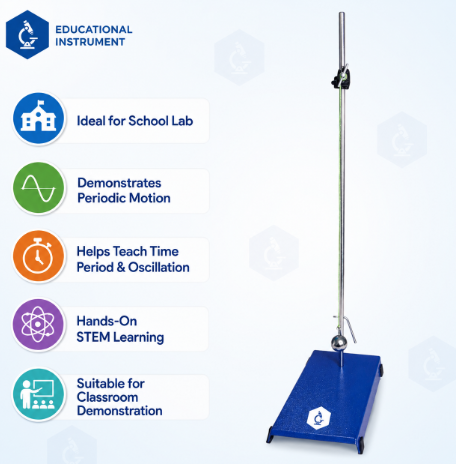
The apparatus avoids flimsy setups by integrating a heavy-gauge cast iron tripod base supporting a rigid steel pillar, completely eliminating non-planar or secondary vibrations during active swings. At the apex, a precision split-cork jaw system or low-friction suspension clamp secures the inextensible cord. This architecture creates an authentic, singular axis point of suspension, allowing the system to approximate an ideal mathematical pendulum. The kit includes multiple interchangeable metallic bobs—comprising brass, copper, and aluminum variants—enabling students to test the parameters of Galileo's isochronism and prove that mass dictates zero bias on the ultimate period of oscillation under a small-angle regime.
Perfect for middle schools, secondary educational institutes, university physics laboratories, and home-based STEM modules, this apparatus seamlessly moves students from textbook kinematics formulas into verified experimental observations. The open design allows students to manually adjust length variables, trace vector trajectories, and easily map calculations for the exact acceleration due to gravity .
Core Pedagogical and Technical Key Features:
Anti-Vibration Base Stabilizer: Heavy, powder-coated cast iron base ensures the vertical upright pillar remains perpendicular and free from lateral movement during extensive lab trials.
Zero-Slip Suspension Mechanism: Features an engineered split-cork clamp configuration to establish a perfectly clean, point-vortex suspension line without string slippage.
Multi-Metallurgy Bob Matrix: Ships with multiple solid spherical bobs of identical diameters but radically different mass densities (Brass, Aluminum, Steel) to challenge student assumptions regarding mass and period vectors.
Integrated Metrics Scalability: Accompanied by a non-stretching linen/nylon cord array and fine adjustments to track changes in length with millimeter accuracy.
STEM Curriculum Integration: Optimized for verifying linear restoration forces, computing center-of-mass offsets, evaluating air damping coefficients, and mapping local values of.
- Product Specifications
|
Parameter Matrix |
Technical Engineering Specification Details |
|
Brand Name |
Educational Instrument India |
|
Product Classification |
Classical Kinematics & Vibrational Dynamics / STEM Lab Equipment |
|
Support Stand Pillar |
Polished chrome-plated solid steel rod, Height: 1000mm, Diameter varnothing: 12.5mm |
|
Base Platform Construction |
Heavy-duty cast iron tripod or rectangular base with corrosion-resistant powder coat |
|
Suspension Assembly |
Solid brass cross-arm with an integrated adjustable split-cork chuck mechanism |
|
Pendulum Bobs Included |
3x Spherical solid bobs with small integrated suspension hooks varnothin 25mm: 1x Brass, 1x Steel, 1x Aluminum |
|
Suspension Line Matrix |
Low-stretch fine braided nylon cord spool (10 meters) with high-contrast indicator markings |
|
Tracking Resolution |
Compatible with standard laboratory meter rules, digital photogates, and stopwatches |
|
Assembled Dimensions |
|
|
Net Apparatus Weight |
Approx. 3.45 kg (High-mass distribution ensures excellent non-slip stabilization) |
- How to Use the Simple Pendulum Apparatus
Ensure optimized laboratory instructional success and maximize experimental accuracy by adhering to these standard physics guidelines:
Expert Lab Instruction Notice: Always measure the pendulum's effective length from the exact bottom edge of the suspension split-cork block to the precise center-of-mass of the metal bob. This requires adding the bob's radius to the measured length of the string .
Assembling the Support Stand: Screw the vertical steel rod firmly into the cast iron base. Place the assembly on a flat, level laboratory bench free from drafts or ambient machine vibrations.
Suspending the Pendulum Bob:
Select the brass bob and measure its diameter with a vernier caliper to find its radius.
Feed the nylon line through the hook of the bob and clamp the upper end securely inside the split-cork jaw assembly.
Adjust the cord so that the distance from the clamp to the top of the bob is exactly 80 cm. The effective length .
Executing Small-Angle Oscillations:
Displace the metal bob laterally by a small distance.
Crucial Condition: Keep the displacement angle under 15 degrees. Exceeding 15 degrees violates the small-angle approximation which introduces non-linear tracking errors into your data.
Release the bob cleanly without giving it a push or side-twist, ensuring it swings back and forth smoothly in a single vertical plane.
Data Collection & Calculating Gravity :
Let the bob complete 3 to 5 reference swings to stabilize its path.
Start a digital stopwatch as the bob passes the central equilibrium point. Count exactly 20 complete oscillations (one oscillation is a full back-and-forth cycle).
Divide the total elapsed time by 20 to isolate the true time period
Instruct students to input their values into the verified simple pendulum time period equation:
Repeat this tracking process at varying lengths (e.g., 60cm, 40cm) to plot an graph, proving the linear slope function.
- Frequently Asked Questions (FAQs)
Q1: Why does the mass or metallurgy of the bob not affect the time period of the pendulum?
A: This behavior reflects one of the foundational principles of gravitational physics: the Equivalence Principle. According to Newton's laws, an object's mass increases its resistance to motion (inertial mass), but it also increases the gravitational pull it experiences (gravitation mass) by the exact same proportion. In the pendulum tracking matrix, these two components cancel each other out completely. Consequently, the restoration acceleration depends entirely on the angle of displacement and gravity, making the time period independent of mass.
Q2: What happens to the calculations if the oscillation angle is pulled open wide past 30 degrees?
A: The elegant mathematical formula is derived using a small-angle approximation where is replaced simply by the value of in radians. If you pull the pendulum open to a wide angle, this assumption breaks down. The true path becomes non-linear, and the actual time period will lengthen slightly compared to the value calculated with the standard formula. Keeping the swing tight (under 15°) ensures your laboratory results map accurately to textbook expectations.
Q3: Why does Educational Instrument India provide a split-cork suspension instead of a standard metal hook?
A: Standard metal hooks or simple knots allow the string to wiggle or shift slightly inside the loop as the pendulum swings, which constantly alters the effective length of the pendulum during an experiment. A split-cork suspension clamps the string firmly along a straight, solid line. This design sets a precise, unmoving pivot point, eliminating friction wear and ensuring highly accurate, repeatable measurements.
Q4: How do we prevent the pendulum from spinning or swinging in an unaligned ellipse?
A: Elliptical tracking or twisting occurs when the bob is released with a slight lateral push or side-twist. To ensure smooth, single-plane oscillations, draw the bob back slowly along a straight path using an index finger, hold it completely still for a second to eliminate hand-shake, and then release it by simply opening your finger downward without any sideways movement.