Step Down Transformer Model STEM Lab
Product Code : SCL-IMIC-12546
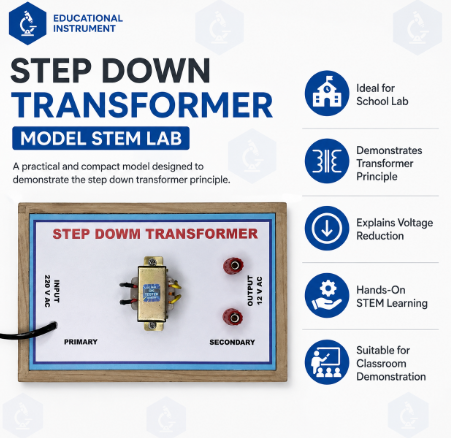
Demystify the principles of electrical engineering and alternating current (AC) networks with the premium Step Down Transformer Model STEM Lab Kit, masterfully manufactured by Educational Instrument India. Built to serve as a cornerstone apparatus for physics laboratories and electrical science workshops, this educational model offers a highly visual and perfectly safe environment for students to witness magnetic flux linkage and voltage transformation in real-time.
The apparatus features an intentionally open, transparent layout, exposing the core components that are normally sealed inside commercial transformers. It consists of a high-permeability, laminated silicon steel U-and-I iron core designed to minimize eddy current losses. Mounted directly onto this core are two distinct, heavy-duty insulated copper wire spools: a primary coil with a high turn count and a secondary coil with a significantly lower turn count. When a safe, low-voltage AC power input is applied to the primary winding, it creates a continuously changing magnetic field within the laminated core. This moving magnetic flux links with the secondary coil, inducing a lower, stepped-down AC voltage across the secondary terminals according to Faraday's Law of Mutual Induction.
Perfect for middle schools, high schools, engineering institutes, and hands-on STEM academy curricula, this educational kit bridges the gap between abstract textbook mathematics and safe, tangible physical manipulation. The circuit schematic and turn counts are printed clearly on the non-conductive insulated baseboard, ensuring students can easily track and document their scientific findings.
Core Pedagogical and Technical Key Features:
Exposed Modular Architecture: Fully viewable, detachable coils and a clamping iron core allow students to physically modify and interact with the transformer's components.
Safe Low-Voltage Engineering: Designed strictly to operate with safe classroom low-voltage AC laboratory power inputs (e.g., 0-12V AC), removing risks associated with high mains voltages.
High-Efficiency Laminated Core: Constructed with professional-grade laminated steel plates, giving an accurate simulation of commercial power grids by reducing heat and parasitic core losses.
Comprehensive Mathematical Validation: Allows students to directly confirm the exact mathematical relationship governing voltage transformation and the turns ratio.
Standard 4mm Safety Terminals: Outfitted with robust, color-coded 4mm safety banana sockets for fast, secure connections to voltmeters, ammeters, and electrical load modules.
- Product Specifications
|
Parameter Matrix |
Technical Engineering Specification Details |
|
Brand Name |
Educational Instrument India |
|
Product Classification |
Electricity & Magnetism / STEM Educational Lab Equipment |
|
Core Architecture |
Interlocking Laminated Silicon Steel Core (U & I configuration) with thumb screw clamps |
|
Primary Winding Coils |
Heavy insulated copper wire wire-wrapped spool (approx. 400 to 800 turns, model dependent) |
|
Secondary Winding Coils |
Multi-tap insulated copper wire spool featuring midway extraction taps (approx. 100 to 200 turns) |
|
Max Recommended Input |
12V AC (Alternating Current) via standard lab step-down transformer or function generator |
|
Interface Connections |
Color-coded 4mm insulated safety binding posts/banana plug sockets |
|
Base Material |
Rigid, scratch-resistant, insulated non-conductive polymer or wood laminate with pre-printed wiring diagram |
|
Dimensions (L x W x H) |
Approx. 200 mm x 140 mm x 110 mm |
|
Net Apparatus Weight |
Approx. 1.85 kg (Heavy mass provides safe non-tip bench stability) |
- How to Use the Step Down Transformer Model
Ensure successful educational experiments and maximize classroom engagement by executing your lab protocols using this standard methodology:
CRITICAL SAFETY NOTICE: Never connect this open transformer model directly into high-voltage wall outlets or household mains lines. It must strictly be powered using an approved, low-voltage AC bench power supply unit.
Mechanical Inspection & Setup: Place the model firmly on a level lab table. Ensure the thumb screws on the interlocking 'I' core are tightened securely against the 'U' core to eliminate any air gaps in the magnetic loop circuit.
Connecting the Primary (Input) Circuit:
Set your external AC power source to its lowest setting (e.g., 2V AC or 4V AC). Ensure it is turned OFF.
Connect two banana cables from the AC output of the power supply to the terminals labeled Primary Winding.
Parallel-connect an AC digital voltmeter across these input sockets to measure the incoming primary voltage .
Connecting the Secondary (Output) Circuit:
Connect a second digital AC voltmeter across the Secondary Winding terminals to track the reduced output voltage .
If running a load test, you can connect a small, low-voltage lab lamp indicator or low-resistance resistor in parallel across these terminals.
Executing and Calculating the Turns Ratio:
Turn ON the lab power supply. Slowly step up the input to 6V AC or 12V AC.
Record the stable values displayed on both meters. Note that the output voltage is significantly less than the input .
Instruct students to verify the core transformer equation:
Where represent the known printed turn counts for the primary and secondary coils, respectively.
Shutdown Protocol: Turn off the external AC power supply unit before disconnecting any laboratory banana patch lines.
- Frequently Asked Questions (FAQs)
Q1: Can this Step Down Transformer model operate using a standard DC power source (like a battery)?
A: No. Transformers rely strictly on a continuously changing magnetic field to induce a voltage in the secondary coil (Faraday's Law). Since Direct Current (DC) generates a static, unmoving magnetic field, mutual induction cannot take place. Connecting a DC battery to the primary winding will simply cause the wire to heat up rapidly without producing any usable voltage output on the secondary side.
Q2: Why does the transformer make a soft buzzing or humming sound when it is powered on?
A: The buzzing sound is a completely normal physical behavior known as magnetostriction. When the alternating current sweeps through the iron core, the changing magnetic fields cause the laminated steel plates to rapidly expand and contract at microscopic levels at the frequency of the AC current (typically 50Hz or 60Hz), vibrating the surrounding air.
Q3: Can we operate this model in reverse to step up a low voltage?
A: Mechanically and theoretically, yes. If you apply a safe, low-voltage AC input into the fewer-turns coil, it can act as a step-up transformer. However, for classroom safety and to prevent accidental high-voltage generation, Educational Instrument India strongly advises using this specific unit strictly in its designated step-down orientation.
Q4: What happens if the thumb screws on the iron core clamp are loose?
A: If the clamps are loose, a tiny air gap forms between the 'U' and 'I' steel elements. This air gap increases the magnetic reluctance (resistance to magnetic flux), which significantly lowers the efficiency of the transformer. This will cause the output voltage to drop below its mathematically calculated value and increase the physical humming sound of the device.