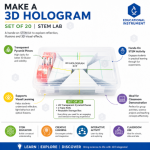
Transverse and Longitudinal Wave using Slinky

Product Code : SCL-OS-12208
Engineered for the empirical visualization of wave propagation, this helical apparatus facilitates the comparative analysis of transverse and longitudinal mechanical waves. Designed for secondary and vocational laboratory environments, it ensures repeatable demonstrations of frequency, amplitude, and wavelength. Compliant with international pedagogical standards, it supports foundational acoustics and wave mechanics modules in university-preparatory STEM curricula.
Technical Specifications
|
Tender Specification |
OEM Technical Detail |
|
Material Grade |
Fatigue-Resistant Tempered Spring Steel / Industrial Polymer |
|
Coil Configuration |
Constant-pitch helical winding for uniform tension distribution |
|
Dimensions |
100mm (Compressed) / Expandable to 3000mm+ |
|
Surface Finish |
Corrosion-resistant high-visibility coating |
|
ISO Compliance Code |
ISO 9001:2015 (Manufacturing Quality Management) |
|
HS Code |
9023.00.00 (Instruments, apparatus and models for demonstrational purposes) |
Key Pedagogical Outcomes (Bloom’s Taxonomy)
Feature: High-Elasticity Helical Geometry. Outcome: Allows students to identify and analyze compressions and rarefactions, supporting "Analyze" level Longitudinal Wave modules.
Feature: Low-Attenuation Material Grade. Outcome: Facilitates the empirical observation of pulse reflection and standing wave formation, aiding the "Evaluate" phase of laboratory inquiry.
Feature: Calibrated Spring Constant. Outcome: Ensures consistent wave speed ($v = f\lambda$) demonstrations across multiple trial runs, supporting "Apply" level physics data recording.
Feature: Modular Expansion Capability. Outcome: Encourages student-led creation of varied wave-interference patterns and nodal analysis, satisfying "Create" level STEM problem-solving objectives.
International Logistics & Compliance
All consignments are secured in export-grade seaworthy crating (ISPM-15 compliant) to prevent mechanical deformation or tangling of the helical structure during multi-modal transit. Documentation provided with each shipment includes the Manufacturer’s Authorization Form (MAF), IQ/OQ/PQ Certification protocols, and comprehensive technical user manuals in English. The instrument features a tropicalized design, validated for material stability and tensile performance in operating environments reaching up to 45°C and 90% non-condensing humidity.
Why Source from the OEM
Procuring directly from the OEM ensures vertical integration and strict adherence to the metallurgical tolerances required for repeatable wave-motion data. Unlike generic consumer-grade springs provided by third-party traders, our Educational Instruments undergo in-house tension testing and batch-testing for elastic limit uniformity. Sourcing from the factory provides immediate access to direct factory spares and manufacturer-level calibration data, mitigating the procurement risks and lack of standardization typical of third-party trader inventory.
.png)
.png)
.png)