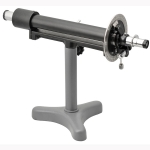
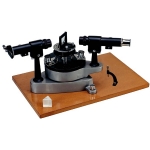
Wooden Spectroscope STEM Lab
Product Code : SCL-OS-12568
The Wooden Spectroscope – STEM Lab by Educational Instruments India is a highly durable, precision-engineered optical testing instrument designed to introduce students to the foundational physics of spectroscopy, wave optics, and light analysis. Housed in an eco-friendly, robustly crafted natural hardwood body, this apparatus isolates light paths to create a highly accurate darkroom chamber for observing split light rays without external ambient light contamination.
Equipped with a high-definition 1000 lines/mm diffraction grating element and an adjustable, ultra-fine adjustable slit assembly, this spectrometer enables users to break down composite light beams into individual monochromatic components. Students can accurately observe distinct spectral lines, continuous emission bands, and absorption gaps. This STEM apparatus bridges the gap between quantum mechanics, atomic structure, and practical astronomy by allowing young scientists to analyze light chemistry safely on any lab bench.
Key Educational Deliverables & Concept Coverage
Fraunhofer Lines & Solar Spectrum: Investigating the chemical composition of light from safely reflected solar sources.
Discrete vs. Continuous Spectra: Distinguishing the monochromatic line signatures of gas-discharge lamps (e.g., Sodium, Mercury) from the continuous spectrum of tungsten filaments.
Diffraction Grating Physics: Practical observation of wavelength dispersion according to the classical grating equation .
Chemical Flame Analysis: Analyzing different elemental salts burned under a Bunsen burner by observing their distinct atomic emission wavelengths.
Technical Product Specifications
|
Brand Name |
Educational Instruments India |
|
Target Demographics |
Middle School, High School Physics, Advanced STEM Labs, and Homeschooling Collectives |
|
Chamber Housing Material |
Seasoned, Kiln-Dried Natural Hardwood with Matte Black Internal Anti-Reflective Coating |
|
Optical Element |
Premium Photographic Grade Diffraction Grating (1000 Lines per mm / 25,000 Lines per Inch) |
|
Slit Configuration |
Machined Brass Blades with Micro-Adjustable Knurled Screw (Adjustable from 0.1mm to 2.0mm thickness) |
|
Wavelength Range |
Visible Light Spectrum (400 nm to 700 nm) with an interior scale indicator grid |
|
Internal Calibration Scale |
Built-in, illuminated nano-meter (nm) reference scale overlay for direct spectral wavelength mapping |
|
Dimensions |
Length: 280mm | Base Width: 65mm | Height: 75mm |
|
Mounting System |
Integrated 1/4-inch universal tripod thread insert underneath the wooden baseboard |
How to Use It: Step-by-Step Guided Experiments
Experiment 1: Identifying Wavelength Elements of Household Lights
Place the Wooden Spectroscope on a level laboratory table. Direct the micro-slit end toward a running fluorescent light tube or a standard LED desk lamp.
Look through the eyepiece containing the diffraction grating on the opposite side of the wooden chamber.
Rotate the knurled brass screw to tighten the slit until the light path narrows down to a fine line.
Observe the internal illuminated grid panel. Notice that a regular incandescent lamp shows a continuous rainbow smear, while energy-saving fluorescent bulbs show bright, isolated green, mercury-blue, and orange line emission bands. Match the locations of these bands against the nanometer scale grid.
Experiment 2: Analyzing Safe Chemical Flame Transitions
Position the adjustable slit aperture roughly 15 cm away from a clean, non-luminous blue Bunsen burner flame.
Dip a clean platinum loop wire into a diluted sample of Sodium Chloride (NaCl) solution, then place the wire tip directly into the flame. The flame will instantly turn bright orange.
Look immediately through the spectroscope eyepiece. You will see a sharp, intense yellow emission signature positioned exactly at 589 nm. This demonstrates the localized atomic de-excitation process of valence electrons.
Optics Care and Preservation Guidelines:
Direct Solar Hazard Warning:NEVER look directly at the sun through the spectroscope. Doing so can cause permanent eye damage. To analyze solar emission profiles, always direct the slit toward a brightly illuminated matte white paper card or wall reflecting sunlight indirectly.
Diffraction Film Protection: Do not touch the clear film inside the eyepiece with bare fingers. Skin oils smudge micro-grooves, reducing optical clarity. Clean using oil-free optical microfiber wipes or compressed air bursts only.
Humidity Management: Because the outer chassis is built of authentic, premium wood, avoid storing the device in high-humidity chambers to prevent microscopic alignment warps.
Frequently Asked Questions (FAQs)
Q1: What advantage does a wooden spectroscope housing have over plastic or cardboard models?
A: Cardboard scopes degrade easily and bend over time, destroying the parallel alignment of the slit and the grating film. Plastic housings can let trace amounts of ambient light bleed through under intense lab illumination. The seasoned wood frame used by Educational Instruments India provides a robust darkroom body that ensures crisp, high-contrast spectral lines.
Q2: Can this spectroscope be calibrated if the lines look slightly shifted?
A: Yes. The reference scale can be horizontally aligned by aiming the unit at a known mercury vapor source (like a common classroom fluorescent tube) and matching the bright green line mark to the 546 nm position.
Q3: Is this product compatible with digital cameras or smartphones?
A: Yes. The flat, wide design of the wooden viewing eyepiece allows you to align a smartphone camera lens flat against it to capture clear digital pictures of spectral bands for lab reports.