Ampere Law Apparatus STEM Lab
Product Code : SCL-M-12566
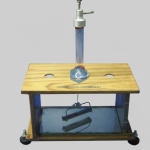
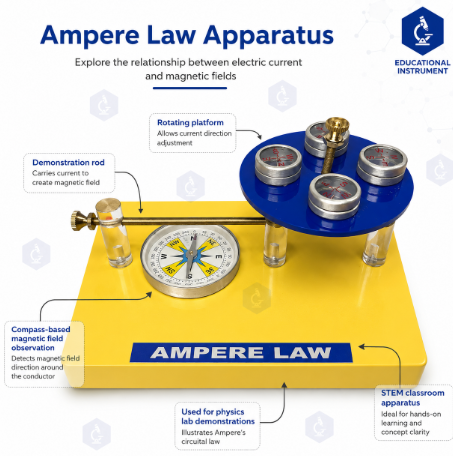
The Ampere's Law Apparatus – STEM Lab by Educational Instruments India is a precision-engineered physics laboratory instrument designed to empirically demonstrate the relationship between an electric current and the magnetic field it generates. This advanced educational tool provides an intuitive setup for high school, university, and STEM academy students to mathematically verify Ampere's Law and explore the Biot-Savart principle.
Featuring heavy-duty conductors, an integrated platform for magnetic sensors or field compasses, and clean geometric structures (including straight-line wires and multi-turn loops), this apparatus eliminates environmental variables to deliver repeatable, accurate metric readings. By converting complex vector calculus equations into interactive laboratory observations, it bridges the gap between theoretical electrodynamics and physical reality.
Key Educational Deliverables & Core Concepts
Magnetic Field Profiles: Mapping the concentric nature of magnetic field lines around a long straight current-carrying wire.
Mathematical Verification: Calculating field strength as a function of the distance from the conductor axis, validating the inverse-distance relationship.
Permeability of Free Space : Quantifying the magnetic constant of a vacuum through data plot slopes.
Geometry Dependence: Investigating how variations in conductor design (straight wire vs. circular loop vs. solenoid coils) shift magnetic field vectors.
Technical Product Specifications
|
Brand Name |
Educational Instruments India |
|
Target Level |
Higher Secondary, College Physics Labs, Engineering Academies, and Advanced STEM Centers |
|
Curriculum Standard |
IIT-JEE Practicals, CBSE, ICSE, International Baccalaureate (IB), Cambridge A-Levels, and College Physics Electrodynamics Syllabi |
|
Conductor Configurations |
• Vertical Straight Line Conductor (Heavy gauge copper rod) |
|
Maximum Current Capacity |
Up to 5 Amperes DC (Continuous operation short duration up to 8 Amperes) |
|
Base and Housing |
Heavy, Non-Magnetic Acrylic/Bakelite Insulated Baseboard (300mm x 200mm) with rubber feet to minimize vibrations |
|
Measurement Indicators Included |
• Built-in Radial Scale (millimeter precision) for exact sensor tracking |
|
Terminal Connections |
4mm Heavy-Duty Shrouded Brass Banana Jack Terminals |
How to Use It: Step-by-Step Guided Experiments
Experiment 1: Verifying Field Direction & Right-Hand Thumb Rule
Mount the straight vertical copper conductor element to the main non-magnetic base plate.
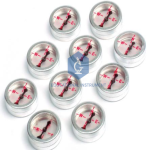
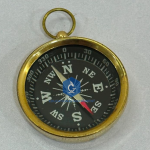
Place the mini-plotting compasses concentrically around the wire at a radial distance of 3 cm. Notice that without current, all needles align to the Earth's geomagnetic North.
Connect the terminal ports to a regulated DC Power Supply (0-5A, 0-12V) through an ammeter. Switch on the current and set it to 3 Amperes.
Observe the instant deflection of the compass needles into a continuous, circular pattern. Apply the Right-Hand Thumb Rule (thumb pointing along the current, fingers curling around the wire) to confirm perfect alignment with the compass direction.
Experiment 2: Quantifying Magnetic Field Intensity
Secure a digital Hall-Effect field probe (Gaussmeter sensor) into the calibrated slider bracket assembly.
Pass a constant current of 4.0 Amperes DC through the straight wire.
Position the probe at a radial distance o from the center of the wire, record the magnetic flux density , and then slide the probe out at incremental steps of 0.5 cm up to 5.0 cm.
Plot a graph . The linear progression cleanly verifies Ampere's Law, and the gradient enables the calculated measurement .
Important Operational Safety Notice:
Thermal Mitigation: High currents through conductors release Joule heat . Do not operate the system continuously at currents exceeding 4 Amperes for longer than 3 consecutive minutes to avoid melting structural plastic mountings.
Power Supply Requirements: Always use a stabilized, smoothed DC power supply. Unregulated AC or high-ripple power will introduce electromagnetic noise, rendering magnetic sensor readings unstable.
Frequently Asked Questions (FAQs)
Q1: Can we use an AC power supply with this Ampere's Law Apparatus?
A: No. Ampere's Law applies to static or steady-state current systems. Alternating Current (AC) constantly shifts direction, making mechanical compasses vibrate back and forth unreadably. A pure DC power source is mandatory for standard field plotting.
Q2: Does the apparatus include a digital Gaussmeter or Tesla-meter out of the box?
A: The standard base kit comes with analog tracking systems and magnetic plotting compasses. The sliding bracket is engineered universally to support standard lab sensors. Digital Gaussmeters can be bundled upon request with Educational Instruments India orders.
Q3: Why is the base of the apparatus made strictly of acrylic and plastic?
A: Ferromagnetic materials like steel, iron, or nickel warp local magnetic flux vectors. By manufacturing the structural body using premium non-magnetic acrylic and pure brass fittings, we guarantee that the measured field lines depend purely on the conductor current geometry.