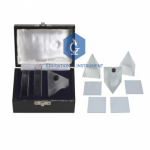
Quick Answer: The Bunsen Grease Spot Photometer compares the luminous intensity of two light sources using a translucent grease-spot diaphragm viewed in two mirrors at once. It slides on 1.5 m or 2.0 m optical benches and mounts on 10 mm or 12 mm rods.
Last updated: October 2026
Key Features
Translucent grease-spot diaphragm of white parchment or paper
Two mirrors show both faces of the spot at the same time
Slider for 1.5 m and 2.0 m optical benches
Fits 10 mm or 12 mm mounting rods, by model
Machined aluminium or steel body with chemical-resistant coating
Technical Specifications
Specification
Value
Screen
Grease-spot diaphragm, white parchment / paper
Viewing
Dual mirror, both faces together
Mounting
Slider for 1.5 m / 2.0 m optical benches
Rod size
10 mm or 12 mm (model dependent)
Body
Aluminium / steel, coated
HS code
9027.50
About This Product
The photometer is placed between two lamps and moved along the bench until the grease spot seems to vanish, which happens when both sides are equally lit. Measuring the distance to each lamp and applying the inverse-square law then gives the ratio of their luminous intensities. Laboratories and colleges in Turkmenistan, Saint Vincent and the Grenadines, Vietnam, Seychelles, Tunisia and Iceland can buy the Bunsen Grease Spot Photometer through an export order.
Frequently Asked Questions
How is the Bunsen Grease Spot Photometer read?
Slide it along the optical bench until the grease spot looks the same as the paper around it in both mirrors; the lamp distances at that null point give the intensity ratio.