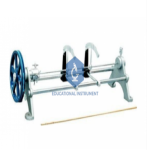
Cycloidal Path Model STEM Lab
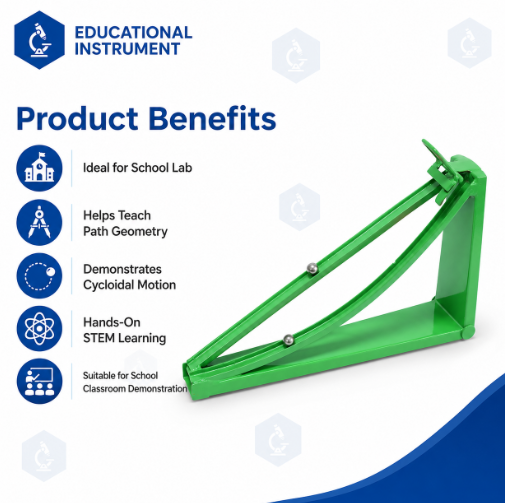
Product Code : SCL-MH-12538
introduce your students to one of the most elegant and surprising puzzles in classical mechanics with the Cycloidal Path Model STEM Lab manufactured by Educational Instrument India. Widely known as the Brachistochrone and Tautochrone apparatus, this high-precision laboratory model provides a clear, undeniable visual proof of the calculus of variations, kinematics, and gravitational acceleration.
When asked to find the fastest path between two points under the influence of gravity, most students naturally guess a straight line. This apparatus challenges that intuition by demonstrating side-by-side how a sphere traveling along a curved, cycloidal path consistently beats a sphere traveling down a straight incline or a parabolic arc. Built for rigorous classroom use, it transforms abstract mathematical physics into an unforgettable, high-impact learning experience.
Key Product Features
Triple-Track Comparative Design: Features three distinct, precisely engineered tracks—a straight line (linear path), a parabolic arc, and a true cycloidal curve—allowing side-by-side race comparisons.
Simultaneous Mechanical Release Gate: Outfitted with a precision-engineered, single-lever mechanical release mechanism that eliminates human error and guarantees perfectly synchronized launches.
Demonstrates Both Classic Paradoxes: * The Brachistochrone Property: Proves the cycloid is the curve of fastest descent.
The Tautochrone Property: Proves that objects released from different heights on the cycloid track will reach the bottom at the exact same instant.
High-Clarity Visual Tracking: Constructed with contrasting, high-visibility backings and track grooves optimized for both naked-eye observation and slow-motion video analysis using smartphones or tablets.
Product Specifications
|
Parameter |
Specification Details |
|
Brand |
Educational Instrument India |
|
Product Name |
Cycloidal Path Model STEM Lab (Brachistochrone Apparatus) |
|
Track Varieties |
1x Straight Line, 1x Parabolic Curve, 1x Cycloidal Curve |
|
Track Frame Material |
Heavy-duty, scratch-resistant optical acrylic mounted on an anodized aluminum profile |
|
Base Construction |
Non-slip solid wooden or heavy metallic base featuring built-in leveling feet |
|
Release Mechanism |
Hand-operated mechanical drop-gate with spring-back trigger |
|
Included Spheres |
3x High-density chrome steel spheres, 3x Low-friction glass spheres |
|
Overall Dimensions |
800 mm (L) x 120 mm (W) x 350 mm (H) |
|
Target Curricula |
AP Physics C (Mechanics), IB Diploma Physics (Advanced Kinematics), B.Sc. Physics, and Engineering Mechanics |
How to Use the Cycloidal Path Model
This STEM apparatus comes fully assembled and calibrated. For the best educational outcome, follow these structured laboratory steps:
Experiment 1: The Brachistochrone Challenge (Fastest Descent)
Level the Apparatus: Place the unit on a flat lab bench and adjust the leveling feet until the built-in spirit level indicates the track profile is perfectly vertical.
Load the Spheres: Lift the mechanical release gate and lock it in place. Position one steel sphere at the top of each of the three tracks (Straight, Parabolic, and Cycloidal).
Trigger the Race: Swiftly press the release lever.
Observe the Results: Note that even though the straight line is the shortest physical distance, the sphere on the cycloidal path reaches the finish line first due to its optimal acceleration profile.
Experiment 2: The Tautochrone Phenomenon (Equal Time)
Prepare the Cycloid Track: Use only the cycloidal path track for this experiment.
Position Spheres at Different Heights: Place one sphere near the top apex of the cycloid curve, and a second sphere much lower, closer to the bottom curve. Hold them in place.
Simultaneous Release: Release both spheres at the exact same instant.
Analyze the Motion: Observe that both spheres collide at the lowest point of the track at the exact same moment. The ball starting higher travels faster over a longer distance, perfectly balancing out the shorter, slower path of the lower ball.
The underlying geometry follows the classic parametric equations of a cycloid generated by a circle of radius :
Safety & Maintenance Note: Keep the track grooves completely free of dust, oil, and moisture. Clean exclusively with a dry microfiber cloth. Do not apply lubricants to the track or spheres, as this can introduce unpredictable hydrodynamic drag.
Frequently Asked Questions (FAQs)
Q1: Why is the cycloidal path faster than a straight line if the straight line is shorter?
While a straight line offers the shortest physical distance, it features a constant, moderate acceleration. The cycloidal path starts with a much steeper drop, allowing the sphere to rapidly build up high kinetic energy and velocity early in the run. Even though it travels a longer total distance, its average velocity is substantially higher, resulting in a quicker total transit time.
Q2: Can this apparatus be used with digital data loggers or photogates?
Yes. The track profiles by Educational Instrument India are designed with standardized clearance spacing, making it incredibly easy to mount external electronic photogates at the starting and terminal points to log transit times down to the millisecond.
Q3: Does the mass of the spheres affect the race outcome?
According to the principles of conservation of energy (neglecting minor rotational inertia and rolling friction variables), gravitational acceleration is independent of mass. If you release a heavy steel ball and a lighter glass ball down two identical cycloidal tracks simultaneously, they will reach the bottom together.
Q4: Is this model durable enough for a busy school tinkering lab?
Absolutely. We construct the track body using thick, high-impact structural acrylic and support it with a rigid base. Unlike cheap plastic alternatives, this apparatus is engineered to withstand daily handling across multiple classroom sections for years.