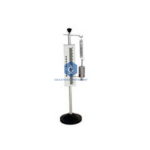
Forces

Product Code : SCL-MH-12591
Demystify the unseen vectors governing our universe with the professional Advanced Forces and Mechanics Demonstration Apparatus, exclusively manufactured by Educational Instrument India. Built to seamlessly translate abstract principles into undeniable physical parameters, this premium academic station is a complete sandbox for executing 22 distinct, high-impact physics experiments.
Forces are the primitive concept of all physical dynamics. This kit allows instructors and students to qualitatively analyze and quantitatively measure how push-and-pull vectors influence structural states, velocities, and gravitational balances. From breaking down the fundamental meaning of words like inertia, active, and passive tension to separating the boundaries between contact forces (such as elastic properties) and non-contact forces (such as gravitational weight fields), this workstation serves as the definitive reference point for secondary and advanced academic physics testing.
Curriculum-Mastery Foundation: Designed specifically to satisfy foundational physics labs across CBSE, NCERT, ICSE, IGCSE, and IB diploma physics criteria.
E-A-T Quality Compliance: Built inside certified ISO 9001:2015 assembly channels, ensuring each spring scale, balancing arm, and vector protractor holds rigorous academic authority and high repeatability.
Complete Hooke’s Law Integration: Transitions seamlessly from qualitative deformation studies into precise quantitative metrics, proving the distinct physical properties dividing plastic and elastic materials.
- Product Specifications
Brand Name: Educational Instrument India
Model Designation: EII-FRC-22X / Premium Dynamics Series
Target Learning Levels: Middle School, High School, and Engineering Laboratory Basics
Structural Engineering Elements: Heavy-duty powder-coated steel backboard panel, anti-corrosive brass fittings, clear acrylic spring housings, and high-tensile alloy weight assemblies.
22-Feasible Experiment Parts Array:
Universal Magnetic Support Backboard Panel with Grid Scale Alignment Matrix
Calibrated Precision Spring Scales (0.5N, 1N, 5N, 10N capacities)
Elastic Steel Leaf Ribbon and Non-Elastic Plastic Deformation Strips
Vector Resolution Hook Hub with 360-degree Magnetic Protractor
Symmetric and Asymmetric Geometric Laminas for Center of Gravity Tracking
Free-Fall Variable Air-Resistance Drop Chamber Subsystem
Hooked Slotted Cast Masses and Counter-balances
Quality Certifications: ISO 9001:2015 Management Systems Verified, CE Mark Structural Tracking Approved
Shipping Net Dimensions: 500 mm x 380 mm x 120 mm
Total Module Weight: 4.95 kg (Shipped in an impact-proof, compartmentalized organizational case)
- How to Use It: Step-by-Step Experimental Core
The module supports 22 feasible experiments. Below are the execution outlines for three primary, essential curriculum activities.
Activity 1: Vector Representation of Forces & Quantitative Scale Calibration
Mount the 360-degree Magnetic Protractor flat onto the steel grid panel.
Hook two calibrated Spring Scales to top anchor points and bring their loops down to meet at a single central vector alignment washer.
Attach a third trailing vertical string holding a known mass hook (e.g., 200g, generating a non-contact force of weight equal to approximately 2N).
Instruct students to read the tension forces displayed on the left and right spring scales.
Map the direction vectors onto the grid paper behind the strings. Use the lines to demonstrate vector representation of forces, proving that the diagonal vector addition of the active scale lines completely cancels the downward gravitational weight vector, ensuring absolute equilibrium.
Activity 2: Separating Plastic Materials from Elastic Materials (Hooke's Law Validation)
Suspend the clear, precision acrylic Spring Scale container vertically from the top structural rail of the backboard.
Record the zero-load point. Add an initial slotted mass weight, and use the integrated millimeter alignment grid to watch how the elastic system stretches quantitatively.
Continue adding weights up to the maximum load limit to plot the relationship between force intensity and length extension, verifying that extension is directly proportional to applied force.
Remove the weight forces. Note how the high-grade spring immediately snaps back to its original length, confirming elastic force characteristics.
Repeat the exact process using the provided plastic testing strip. Show students how it deforms permanently without returning to its shape, perfectly illustrating the behavioral boundaries separating plastic materials from elastic materials.
Activity 3: Center of Gravity Analysis & Free Fall Behavior
Finding Center of Gravity: Pivot an irregularly shaped acrylic sheet lamina from an off-center suspension pin on the backboard. Hang a weighted plumb line from that same pin. Trace the line across the surface. Repeat from a different suspension hole. The intersection coordinate marks the absolute center of gravity. Prove its accuracy by balancing the entire irregular plate on top of a single thin support pointer.
Free-Fall Verification: Drop a heavy solid metal sphere and a lightweight wood orb simultaneously from the top mechanical clamp release tool down into the target cushion. Show that they impact at identical time gaps, verifying whether heavy or light bodies fall first when air resistance parameters are minimized.
- Frequently Asked Questions (FAQ)
Q1: What separates a contact force from a non-contact force in these experiments?
Ans: The kit contains components specifically tailored to demonstrate both. A contact force requires physical intersection between materials, represented in this kit by the mechanical stretch of an elastic spring or the friction of a block sliding on the track. A non-contact force acts through a localized vector field without physical contact, such as the down-pulling effect of weight or the planetary attraction model showing why the moon does not fall on the earth.
Q2: How do you calibrate or adjust the zero-point on the included spring scales?
Ans: Every precision spring scale from Educational Instrument India features a knurled brass zero-adjustment nut at the top apex. Before hanging load masses, simply rotate the nut until the pointer sits precisely over the 0N marker.
Q3: Can this system demonstrate why the weight of an object does not remain constant across different spatial planes?
Ans: Yes. The curriculum guide walks students through the differences between absolute mass and changing gravitational weight fields, providing structural models that demonstrate how variations in orbital velocity, altitude limits, or planetary body sizes alter weight values even while structural mass remains constant.
Q4: Is the entire structural apparatus backed by replacement warranties for academic procurements?
Ans: Yes. Educational Instrument India protects all shipments with a comprehensive industrial warranty framework against manufacturing defects, maintaining a full inventory of replacement springs, slotted weight blocks, scales, and line assemblies.