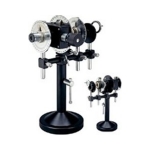
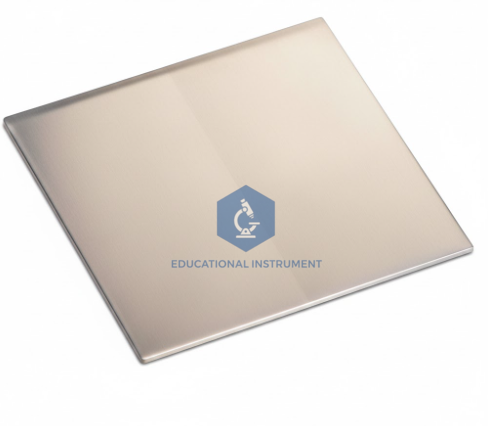
Quick Answer: The Fresnal’s Bi-Prism is a crown glass biprism made of two acute-angled prisms joined base to base, with an obtuse angle of approximately 179°. It splits a wavefront to produce interference fringes and comes in 40 mm x 32 mm and 50 mm x 40 mm sizes.
Last updated: October 2026
Key Features
Crown glass, ground
Two acute-angled prisms joined base to base
Obtuse angle approximately 179°
Two sizes: 40 mm x 32 mm and 50 mm x 40 mm
For use on an optical bench
Technical Specifications
Specification
Value
Material
Crown glass
Configuration
Two acute-angled prisms joined base to base
Obtuse angle
Approx. 179°
Sizes
40 mm x 32 mm; 50 mm x 40 mm
HS Code
9023.00.90
About This Product
A Fresnel biprism divides light from a single slit into two virtual coherent sources, so that interference fringes form without a double slit. On an optical bench with a sodium lamp and micrometer eyepiece, students measure the fringe width and source separation to calculate the wavelength of monochromatic light. The Fresnal’s Bi-Prism can be supplied on export terms to Tanzania, Paraguay, Lesotho, Madagascar, Botswana and Democratic Republic of the Congo.
Frequently Asked Questions
What is the angle of the Fresnal’s Bi-Prism?
Its obtuse angle is approximately 179°, formed by two acute-angled prisms joined base to base.



.png)