Kinetic Theory Model STEM Lab
Product Code : SCL-MH-12540
Bridge the gap between microscopic molecular behavior and macroscopic thermodynamic laws with the professional Kinetic Theory Model STEM Lab designed and manufactured by Educational Instrument India. Built specifically for high school physics labs, university chemistry departments, and advanced STEM centers, this apparatus provides an unforgettably vivid, real-time visual representation of how ideal gas molecules move, collide, and react under varying thermal and volumetric conditions.
Instead of asking students to simply memorize abstract concepts like Maxwell-Boltzmann distributions, ideal gas behaviors, or Brownian motion, this mechanical simulator utilizes precision-vibrated micro-spheres to perfectly mirror molecular kinetics. It is an indispensable, heavy-duty instructional tool for any educators dedicated to interactive, experiential science.
Key Product Features
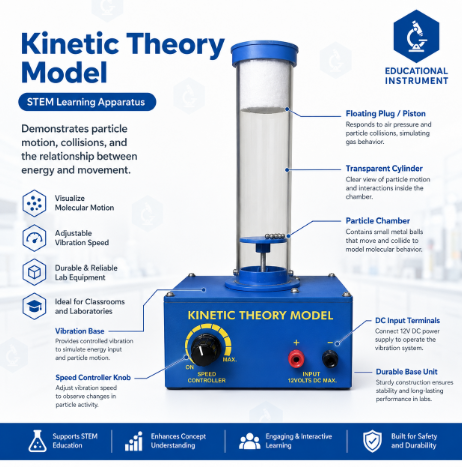
Dynamic Variable Vibration Drive: Powered by a high-torque, variable-speed internal motor that allows educators to precisely simulate changes in temperature by altering the kinetic energy input of the "molecules."
Adjustable Volumetric Chamber: Outfitted with a heavy, low-friction floating piston assembly that permits real-time adjustments to volume and visually demonstrates pressure balances.
Multi-Mass Molecular Simulation: Supplied with standard sets of metal spheres of varying weights and sizes, allowing students to observe how lighter vs. heavier gas molecules behave at identical energy levels.
Crystal-Clear 360° Inspection Cylinder: Constructed using a heavy-walled, optical-grade acrylic chamber that ensures maximum safety while maintaining unobstructed visibility for an entire classroom or lecture hall.
Product Specifications
|
Parameter |
Specification Details |
|
Brand |
Educational Instrument India |
|
Product Name |
Kinetic Theory Model STEM Lab |
|
Chassis Construction |
Powder-coated steel base with isolation rubber dampening feet |
|
Chamber Material |
Scratch-resistant, high-impact optical acrylic cylinder |
|
Drive System |
Low-voltage DC motor with precision linear speed potentiometer |
|
Power Adaptation |
Safe 12V DC input (Universal AC/DC adapter included) |
|
Simulated Molecules |
50x Small Steel Spheres, 50x Large Steel Spheres, 20x Lightweight Polymer Spheres |
|
Piston Assembly |
Floating, graduated compression disk for manual volume manipulation |
|
Target Curricula |
CBSE/ICSE Chemistry & Physics (Kinetic Theory of Gases), AP Physics 2, IB Physics |
How to Use the Kinetic Theory Model
This STEM lab model comes fully calibrated and ready for plug-and-play operation on any stable laboratory workbench.
Load the Simulated Molecules: Remove the top piston cap and place a specific quantity of small steel spheres (representing homogenous gas atoms) into the acrylic chamber.
Seal and Power the System: Lower the floating piston assembly back into the cylinder. Connect the 12V safe DC adapter to the base and plug it into a standard wall socket.
Simulate Temperature Changes: Turn the power switch ON and slowly rotate the speed knob. The vibrating base plate will begin agitating the spheres.
Observation: Low speeds mimic a low-temperature gas (slow, packed molecular motion). High speeds mimic high temperatures, causing the spheres to fly violently throughout the chamber volume.
Demonstrate Boyle’s Law : Maintain a constant vibration speed (constant temperature). Manually push down on the floating piston to reduce the internal volume. Observe how the rate of sphere collisions against the piston face increases dramatically—visually proving how reducing volume increases pressure.
Demonstrate Charles’s Law : Allow the piston to float freely under its own weight (constant pressure). Gradually increase the vibration speed (increasing temperature).
Observation: The increased kinetic energy forces the molecules further apart, physically lifting the floating piston upward and increasing the volume of the gas chamber.
Safety & Maintenance Note: Never run the vibration drive at maximum speed without the piston assembly securely locked inside the cylinder track. Wipe down the interior of the acrylic chamber with an anti-static cloth to prevent static electricity from making the micro-spheres stick to the cylinder walls.
Frequently Asked Questions (FAQs)
Q1: How does this model explain pressure on a molecular level?
In an ideal gas, pressure is not a static force; it is the net result of billions of micro-collisions by moving gas molecules hitting the walls of their container. In this model by Educational Instrument India, students can literally see the floating piston being supported in mid-air solely by the continuous upward bombardment of the vibrating steel spheres.
Q2: What is the benefit of including spheres made of different materials?
By mixing the heavy steel spheres with the lightweight polymer spheres, the model clearly illustrates Graham’s Law of Effusion/Diffusion and the principles of partial pressures. At the exact same vibration speed (temperature), students will observe that the lighter polymer spheres move with a significantly higher velocity than the heavier steel spheres, verifying that.
Q3: Can this device be run continuously during long exhibition cycles?
Yes. The Kinetic Theory Model is built with an industrial-grade, low-heat DC motor and structural dampening. While it is engineered for standard lab periods and demonstrations, it can comfortably run continuously for open-house exhibitions or museum displays.
Q4: Does the kit require any external gas tanks or vacuum lines?
No. The system uses solid spheres moving within ambient room air to mechanically simulate gas laws. It is completely self-contained and does not require compressed air lines, vacuum pumps, or dangerous thermal elements.