
Lamps in Series Kit STEM Lab
Product Code : SCL-EI-12574
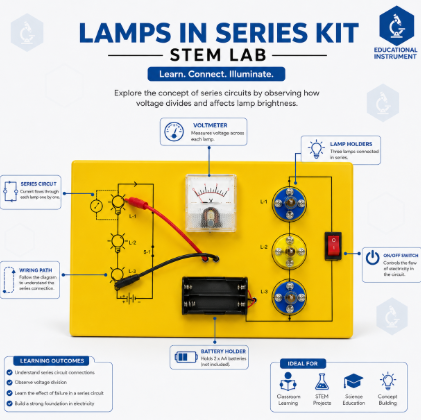
Introduce students to the fundamental principles of electricity and linear network analysis with the laboratory-grade Lamps in Series Kit STEM Lab, engineered and manufactured by Educational Instrument India. As an industry-leading provider of certified scientific apparatus, we have built this high-durability educational kit to provide a vivid, tactile, and mathematically precise demonstration of electric current flow, cumulative resistance, and voltage drop across a single-path loop.
Unlike fragile hobby boards or messy breadboard components, our professional-tier STEM Lab is structured on a high-insulation, impact-resistant ABS composite chassis. A high-contrast, scratch-proof circuit schematic is printed directly onto the panel surface, bridging the gap between abstract textbook wiring symbols and physical hardware. The board features multiple standard light bulb sockets arranged in a strict sequential series configuration, forcing the electrical current to travel along a single, continuous pathway.
Perfectly aligned with middle school science modules, high school physics courses, and introductory polytechnic labs, this instructional instrument allows educators to demonstrate core electrical properties safely. It provides an immediate visual answer to how Christmas tree light strings or basic electrical safety fuses operate, highlighting the real-world implications of circuit breaks.
Key Features and Benefits
Single-Pathway Analysis: Provides a clear visual explanation of series networks, showing that if the current pathway is interrupted at any single point, the entire circuit becomes non-operational.
Proportional Voltage Degradation: Visualizes how adding more loads to a series chain causes individual light bulbs to grow dimmer, introducing the concept of shared voltage drop.
Surface-Printed Laboratory Blueprint: Heavy-duty silk-screened circuit paths on the panel guide students through step-by-step assembly and troubleshooting workflows.
Shrouded 4mm Banana Sockets: Uses industry-standard, gold-plated or nickel-plated 4mm connection nodes and fully insulated cables, preventing short circuits and providing zero-shock student operations.
Integrated Multimeter Evaluation Ports: Positioned inline next to each component branch, allowing quick insertion of ammeters and voltmeters without dismantling structural wires.
Product Specifications
|
Parameter |
Specifications |
|
Brand Name |
Educational Instrument India |
|
Product Name |
Lamps in Series Kit STEM Lab |
|
Model SKU |
EII-STEM-LSK-2026 |
|
Chassis Material |
Flame-retardant, high-dielectric industrial ABS polymer |
|
Circuit Configuration |
3-Socket sequential linear layout with inline toggle control |
|
Connector Terminals |
4mm safety insulated brass banana jacks |
|
Operating Voltage |
3V to 6V DC (Safe, low-voltage educational thresholds) |
|
Quality Certifications |
ISO 9001:2015 Quality Management Certified, CE Standards Approved |
|
Package Box Contents |
1 Lamps in Series Panel, 5 Low-Voltage Miniature MES Threaded Lamps, 6 Insulated Coaxial Banana Patch Cables, 1 Step-by-Step Instructor’s Lab Guide |
How to Use It
The Lamps in Series Kit STEM Lab is optimized for quick plug-and-play classroom experiments. Follow this structured pedagogical sequence to measure, verify, and document circuit performance:
Workstation Preparation: Situate the series circuit trainer board on a flat, dry laboratory desk. Make sure the main power switch on your variable power supply is deactivated.
Completing the Series Chain: Insert the included miniature MES lamps tightly into each socket base. Use the provided banana plug patch cables to connect the positive terminal of your power input to the first bulb input, then jump from the first bulb output to the second bulb input, and finally route back to the negative terminal.
Activating the Circuit Loop: Connect a low-voltage DC power source (such as a 3V–6V battery box or a regulated benchtop power unit) to the input jacks. Switch the power supply on. Observe that all light bulbs glow simultaneously, but at a noticeably dimmer intensity compared to a standalone bulb configuration.
Simulating a Circuit Break: While the circuit is fully active, carefully unscrew the first light bulb from its seat. Note that all remaining bulbs instantly go dark. Reinsert the bulb and repeat the step with the middle or final bulb to demonstrate that an open circuit anywhere along a single loop blocks current across the entire framework.
Quantifying Kirchhoff’s and Ohm’s Laws: Connect digital meters to the test points to verify equations:
Measure the voltage drop across each individual lamp to show that the sum of parts equals total.
Measure current at different entry and exit ports to prove that current remains completely uniform throughout a series path.
Compute total internal resistance using the additive formula:
Frequently Asked Questions (FAQs)
Q1: Why do the bulbs burn noticeably dimmer in this series kit compared to a parallel kit?
Ans: In a series arrangement, the total electrical pressure (voltage) from the source is shared across all connected bulbs. If you hook up three identical lamps to a 6V supply, each bulb only receives approximately 2V. Because individual voltage drops reduce the power delivered to each lamp, the bulbs burn dimmer than they would on their own.
Q2: What happens if one bulb burns out or is removed from the socket?
Ans: Because a series circuit offers only one continuous path for electricity to follow, any break or failure acts like a physical wall. Unscrewing or blowing a single bulb breaks the continuous path, causing the current to drop to zero and turning off all the remaining operational bulbs in the loop.
Q3: Can this laboratory board be powered directly from a standard wall outlet?
Ans: No. For student safety, this STEM lab apparatus is designed only for low-voltage DC inputs (3V to 6V). It must be powered using classroom battery trays or regulated benchtop power supplies. Never hook up this unit to high-voltage AC wall sockets.
Q4: What makes the Educational Instrument India kit superior to standard DIY wire setups?
Ans: Standard DIY setups rely on bare wire loops and loose alligator clips that slip, cause short circuits, or introduce stray resistance. Our professional trainer panel uses solid-state trace connections beneath an insulated board shell and 4mm shrouded banana jacks. This provides highly durable, reliable connections that generate reproducible scientific data across multiple class sessions.
Q5: Are replacement bulbs readily available when the included ones wear out?
Ans: Yes. The trainer panel uses standard low-voltage miniature MES threaded bulbs, which are widely available. Educational Instrument India also stocks individual replacement kits containing matching bulbs, jumper lines, and hardware panels to keep your school science lab fully supported.

.png)

.png)


.png)