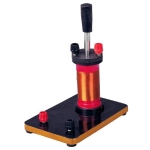
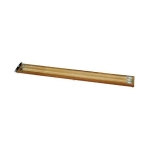
Quick Answer: The Mutual Induction Model has separate primary and secondary coils that fit one inside the other, with a removable laminated soft-iron core. Switching current in the primary induces an e.m.f. in the secondary, the principle behind transformers.
Last updated: October 2026
Key Features
Independent primary and secondary coils on insulated spools, fitted coaxially
Removable laminated soft-iron core rod
4 colour-coded 4mm banana terminal binding posts
For use with transient DC pulses or AC
Maximum input 6V DC / 12V AC
Non-conductive moulded ABS base
Technical Specifications
Specification
Value
Coils
Primary and secondary, insulated copper magnet wire
Core
Removable laminated soft-iron rod
Terminals
4 x 4mm banana binding posts, colour-coded
Maximum input
6V DC / 12V AC
Base
Moulded ABS, non-conductive
About This Product
With the primary inside the secondary and a centre-zero galvanometer on the secondary, pressing a tap key in the primary circuit makes the needle kick one way and releasing it makes it kick the other, showing that an e.m.f. is induced only while the field is changing. Pulling the iron core out and repeating shows a much smaller deflection, which explains why transformers use iron cores to link the coils.
Frequently Asked Questions
What does the soft-iron core do in the Mutual Induction Model?
It concentrates the magnetic flux linking the two coils. With the core removed, the induced deflection in the secondary circuit drops sharply.
What is the maximum input for the Mutual Induction Model?