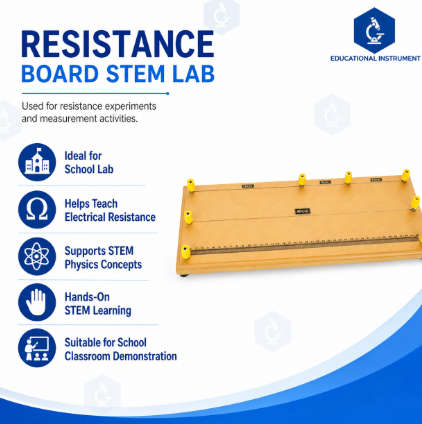
Quick Answer: The Resistance Board is an insulated board carrying test wires of different materials, lengths and thicknesses, with a metric scale alongside. Connected to an external circuit, it shows how material, length and cross-section affect resistance.
Last updated: October 2026
Key Features
Test wires of nichrome, constantan, copper and brass
Wires of different lengths and gauges for comparison
4mm insulated connection terminals at each end
Metric ruler with mm/cm graduations running beside the wires
Connects to an external DC supply, ammeter and voltmeter or multimeter
Technical Specifications
Specification
Value
Wire types
Nichrome, constantan, copper, brass
Connection terminals
4mm insulated
Built-in scale
Metric ruler, mm/cm graduations
Use
Resistivity, length and cross-section experiments
About This Product
Comparing wires of the same size but different metals shows the effect of resistivity, while moving a clip along one wire shows resistance rising in step with length. Switching between a thick and a thin wire of the same material shows a smaller cross-section giving higher resistance. Students calculate each value with Ohm’s law and plot resistance against length.
Frequently Asked Questions
Why take readings quickly on the Resistance Board?
Current heats the wire, and resistivity changes with temperature. Short readings avoid errors caused by the wire warming up.

.png)
.png)

.png)
.png)