Wave Motion Apparatus (18 Pulleys) STEM Lab
Product Code : SCL-EI-12544
Deconstruct complex wave mechanics and wave propagation theories with the premium-grade Wave Motion Apparatus (18 Pulleys) STEM Lab Kit, exclusively manufactured by Educational Instrument India. Designed for high clarity, precision mechanics, and structural longevity, this classical demonstration apparatus offers an invaluable hands-on approach to teaching core periodic motion and kinematics concepts within modern STEM curricula.
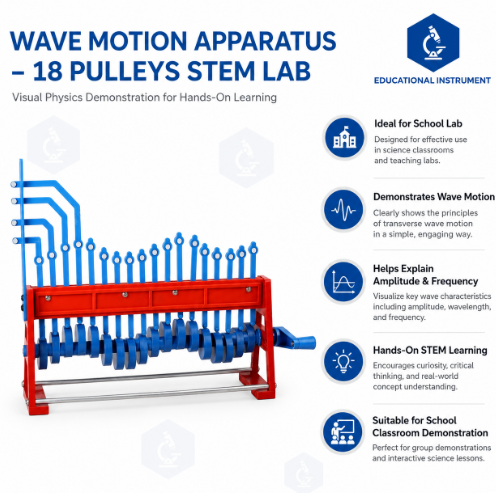
The apparatus consists of a robust mechanical crankshaft assembly hosting 18 precisely engineered eccentric pulleys/cams. Each pulley is keyed sequentially along a central rotary axis at a uniform phase angle deviation relative to its neighbor. Vertical guide rods, topped with highly visible, brightly colored indicator spheres, rest directly on these cams. Turning the hand crank transforms the continuous rotational input into synchronous harmonic vertical motion. The resultant physical displacement creates a mesmerizing, continuous transverse wave progression that travels seamlessly across the device profile.
Engineered explicitly for K-12 classrooms, technical institutes, and university physics laboratories, this apparatus allows instructors to physically slow down, pause, and analyze properties of waves that are traditionally invisible or too rapid to witness in natural environments.
Key Features & Pedagogical Benefits:
18-Pulley High-Resolution Matrix: Outfitted with 18 individual eccentric cams to generate a dense, fluid, and high-fidelity mechanical wave simulation.
Crystal-Clear Concept Visualization: Simplifies abstract physics parameters, including wavelength , amplitude , frequency, period , crests, troughs, and phase differences.
Heavy-Duty Structural Frame: Built using an industrial metal base and rigid vertical guide grids to prevent binding, reduce friction, and survive rigorous daily classroom use.
High-Contrast Target Elements: Guided rods feature vivid, brightly color-coded terminal spheres, making wave configurations highly distinguishable even from the back of a large lecture hall.
Completely Manual & Interactive: Operates strictly via a smooth-action hand crank. By altering the speed of rotation, users directly control and experience the relationship between frequency and wave speed.
- Product Specifications
|
Parameter |
Technical Specification Details |
|
Brand Name |
Educational Instrument India |
|
Product Classification |
Wave Mechanics / Kinematics STEM Apparatus |
|
Mechanism Framework |
18 Sequentially Offset Eccentric Aluminum/Nylon Cams |
|
Drive Type |
Manual Hand Crank with low-friction bearing support |
|
Frame Construction |
Heavy-gauge sheet steel base with a durable powder-coated finish |
|
Indicator Elements |
18 Vertical Steel Rods with High-Visibility Molded Spheres |
|
Wave Type Simulated |
Continuous Transverse Traveling Waves |
|
Dimensions (L x W x H) |
Approx. 450 mm x 120 mm x 300 mm |
|
Net Weight |
Approx. 2.2 kg (Providing excellent stability during operation) |
- How to Use the 18-Pulley Wave Motion Apparatus
Maximize classroom learning outcomes by using these standardized procedural steps for demonstration and measurement:
E-A-T Instruction Tip: Always make sure the apparatus is placed on a completely level, vibration-free laboratory bench. Ensure the vertical tracking rods move smoothly within their slots before starting the demonstration.
Initial Alignment & Calibration: Place the apparatus on a level table. Ensure all 18 vertical rods are sitting flush against their respective eccentric pulleys. Verify that the hand crank turns smoothly in a clockwise direction.
Demonstrating Transverse Wave Propagation:
Turn the hand crank slowly at a steady, uniform pace.
Instruct students to observe the colorful indicator spheres. Note how individual rods move exclusively up and down (perpendicular to the wave direction), while the overall wave shape propagates horizontally from left to right. This perfectly defines a transverse wave.
Identifying Wave Parameters:
Stop cranking to freeze the wave at a specific point.
Use a laboratory ruler to measure the distance between two consecutive highest points (crests) to find the wavelength ($\lambda$).
Measure the height from the central equilibrium line to the highest peak to identify the wave's amplitude ($A$).
Exploring Frequency and Phase:
Increase the cranking speed. Demonstrate that as the rotation frequency increases, the frequency of the wave increases correspondingly.
Have students focus their eyes on just one single rod. Show how its cyclical motion lags slightly behind the rod before it, providing a physical, undeniable example of a phase constant.
- Frequently Asked Questions (FAQs)
Q1: Can this apparatus demonstrate longitudinal (sound) waves?
A: This specific 18-pulley arrangement is designed to demonstrate transverse waves, where particle displacement is perpendicular to the direction of wave travel. For longitudinal wave mechanics, we recommend pairing this unit with a classic helical slinky or a dedicated longitudinal wave model from Educational Instrument India.
Q2: Does the unit require any regular maintenance or lubrication?
A: The mechanical cams and guide grids are engineered for dry, low-friction operation to keep your lab environment clean. However, applying a tiny drop of light machine oil or silicone spray to the central crankshaft bearings once a year ensures smooth operation over decades of use.
Q3: Is the apparatus shipped pre-assembled, or is assembly required?
A: To protect the alignment of the 18 delicate guide rods during international transport, the unit is securely packaged and arrives fully assembled. Simply unbox it, place it on your lab station, and it is ready for immediate operation.
Q4: How do the 18 pulleys create the illusion of a moving wave if they are fixed?
A: This is a brilliant example of mechanical engineering imitating math. Each of the 18 pulleys is set on the shaft with a uniform angular offset (e.g., 20 degrees out of phase with the next). When spun, they collectively form a physical Sine/Cosine wave profile that appears to move forward through space, mimicking continuous periodic wave equations.
.png)



.png)