
Persistence of Vision Model STEM Lab
Product Code : SCL-OS-12569
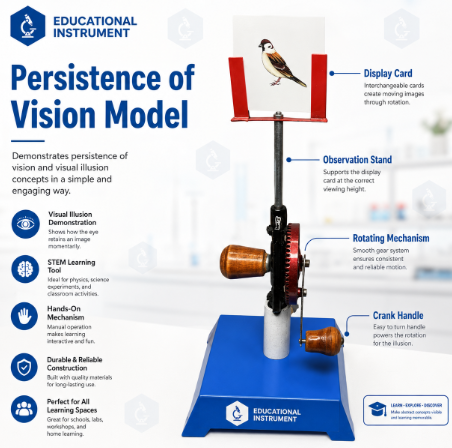
The Persistence of Vision Model manufactured by Educational Instrument India is an exceptional, high-utility STEM lab instrument designed to visually demonstrate the fundamental principles of optical illusion, animation, and human sensory memory. This high-grade experimental model bridges the gap between biological anatomy and cognitive physics by demonstrating how the human eye and brain process rapid succession of individual static images.
This classical apparatus utilizes a dual-sided mechanical spinning mechanism. When the high-contrast graphical cards (such as the classic "Bird in a Cage" or "Fish in a Bowl" configurations) are rotated at a specific rotational velocity, the discrete images on either side blend seamlessly into a single composite image. This provides an undeniable, hands-on verification of retinal persistence—the physiological phenomenon where an image continues to be perceived by the retina for approximately 1/10th to 1/16th of a second after the actual light source has vanished.
Key Learning Outcomes & Curriculum Alignment:
Biological Optics: Explores the role of retinal processing speed, chemical reaction lags in rods and cones, and iconic sensory memory.
Cinematic Frameworks: Illustrates the underlying mechanics of modern cinematography, animation, and digital display refreshing.
Kinematics & Rotational Dynamics: Demonstrates the threshold frequency required to convert discrete temporal frames into continuous visual motion.
Product Specifications
Engineered for structural durability and repeatable classroom measurements, this STEM model features robust industrial materials and reliable mechanics:
|
Technical Specification Parameters |
Product Value details |
|
Manufacturer / Brand |
Educational Instrument India |
|
Structural Frame Material |
Heavy-duty, corrosion-resistant alloy base with an integrated low-vibration mounting tower |
|
Actuation Mechanism |
Precision-balanced manual pulley and drive-belt system (High Gear-Ratio for smooth acceleration) |
|
Optical Target Dimensions |
Double-sided, 100 mm diameter high-contrast laminated graphics discs |
|
Supplied Demonstration Templates |
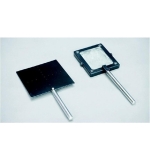
Bird in the Cage, Fish in the Bowl, Empty Window/Character, and customizable blank discs |
|
Product Weight (Approx.) |
1.2 kilograms (provides high stability during fast rotation) |
|
Total Assembly Dimensions |
250 mm (Length) × 150 mm (Width) × 300 mm (Height) |
How to Use the Persistence of Vision Model
Ensure accurate, repeatable experimental results in your laboratory by following this systematic operational framework:
Bench Positioning: Place the Educational Instrument India apparatus on a level, solid laboratory workbench. Ensure there is unobstructed clearance around the rotating card holder.
Card Selection: Insert your chosen double-sided demonstration disc (e.g., the bird and the cage template) securely into the centralized metallic clamping slot on the rotating wheel axle.
Static Evaluation: Direct students to observe the card from a fixed frontal viewpoint while it is completely stationary. Have them note down that they explicitly perceive two separate, non-overlapping images on front and back surfaces.
Gradual Acceleration: Rotate the hand crank slowly. At low rotational speeds, the observer will see the images flipping back and forth in a jerky, disconnected sequence.
Achieving Fusion Frequency: Increase the hand crank speed steadily until the rotational frequency exceeds roughly 10 to 16 cycles per second. At this specific operational threshold, observe how the two independent drawings merge flawlessly into a single composite image—displaying the bird perfectly settled inside the cage.
Deceleration Observation: Allow the wheel to slowly lose momentum and ask the students to identify the exact point where the sensory illusion breaks down and returns to fragmented individual frames.
Frequently Asked Questions (FAQ)
Q1: What is the biological cause behind the Persistence of Vision phenomenon?
A: When light stimulates the photoreceptors (rods and cones) within the human retina, the neurological signaling pathway to the brain stays active for a fraction of a second after the stimulus stops. This brief chemical lag gives the brain enough time to blend closely timed successive images together into a single, continuous perception.
Q2: Why does the merged image begin to flicker at certain rotation speeds?
A: If the rotational frequency drops below the critical fusion threshold (around 10-12 Hz), the brain registers the gaps where light from the target ceases to enter the eye. This transition zone is exactly what causes the visual sensation of flickering.
Q3: Can students create custom experiments with this specific model?
A: Yes. The apparatus by Educational Instrument India includes multiple blank, thick-grade erasable templates. Students can draw custom progressive or dual-part graphics to test their own optical parameters and threshold limits.
Q4: What maintenance is required to ensure long-term laboratory durability?
A: The mechanical assembly is designed to be virtually maintenance-free. Periodically check the alignment of the driving belt, keep the drive axle free of dust buildup, and store the laminated optical templates in a dry, dark folder to preserve their high-contrast colors.
.png)



.png)