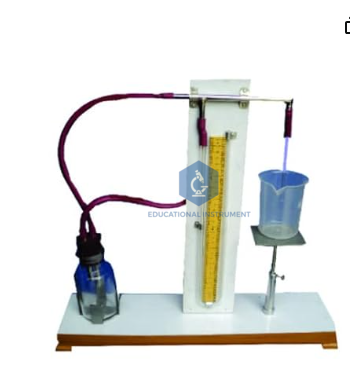
Quick Answer: Jaeger’s Surface Tension Apparatus measures surface tension by the maximum bubble pressure method, using a fine vertical capillary, a U-tube manometer and a graduated aspirator. The glass parts are borosilicate.
Last updated: October 2026
Key Features
Borosilicate glassware
Vertical U-tube manometer on a graduated scale
Graduated glass aspirator with control stopcock
Fine-bore vertical capillary
Powder-coated base or wooden stand
Technical Specifications
Specification
Value
Glass
Borosilicate
Manometer
Vertical U-tube on graduated scale
Aspirator
Graduated glass vessel with stopcock
Capillary
Fine-bore, vertical
Stand
Powder-coated base or wood
About This Product
Water let out of the aspirator slowly draws air through the capillary dipped in the test liquid, and the manometer shows the pressure at which each bubble breaks away. That maximum pressure gives the surface tension, so different liquids and concentrations can be compared. Schools, colleges and institutes in Belize, Uzbekistan, Brazil, Morocco and Sudan can order the Jaeger's Surface Tension Apparatus from Educational Instrument.
Frequently Asked Questions
Which method does Jaeger’s Surface Tension Apparatus use?
It uses the maximum bubble pressure method, reading the pressure on a U-tube manometer as bubbles form at a fine capillary.