Poisson's Ratio of Rubber Apparatus
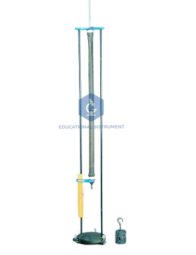
Product Code : SCL-MH-11956
This precision educational instrument is engineered for the empirical determination of Poisson’s ratio in elastomeric materials through the measurement of longitudinal and lateral strain.1 Designed for University and Vocational technical labs, the apparatus facilitates high-accuracy volumetric and linear deformation analysis. It complies with fundamental mechanical testing protocols and is optimized for rigorous, repeatable use in undergraduate physics and engineering material characterization modules.
Technical Specifications
|
Tender Specification |
OEM Technical Detail |
|
Primary Material |
Heavy-duty Cast Iron Base with Powder-Coated Finish |
|
Specimen Type |
High-elasticity Vulcanized Rubber Tube |
|
Specimen Length |
Approximately 1000 mm (1 meter) |
|
Measurement Accuracy |
0.01 mm displacement resolution capability |
|
Linear Scale |
Integrated Metric Scale with Adjustable Pointer |
|
Volumetric Interface |
Integrated Burette/Manometer connection port for $\Delta V$ monitoring |
|
Loading Mechanism |
Stainless Steel Hook and Hanger for Slotted Weights |
|
Base Stability |
Leveling screws for vibration-damped vertical alignment |
|
HS Code |
9023.00 (Instruments, apparatus and models, designed for demonstrational purposes) |
Key Pedagogical Outcomes
Strain Ratio Quantification: Facilitates the direct measurement of lateral vs. longitudinal deformation, enabling students to calculate \sigma (Poisson’s Ratio) for incompressible materials .
Volumetric Conservation Analysis: Utilizing the water-filled tube method, learners observe the relationship between axial elongation and internal volume displacement, supporting Thermodynamics and Fluid Mechanics modules.
Elastic Limit Verification: Allows for the plotting of Stress-Strain curves to identify the proportionality limit and Hooke’s Law compliance in elastomers.
Precision Instrumentation Literacy: Hardware interaction with vernier scales, pointers, and volumetric burettes develops foundational metrology skills required in ISO-standardized testing environments.
International Logistics & Compliance
As a specialized OEM, we ensure all units are prepared for global distribution via export-grade, seaworthy crating (ISPM-15 compliant) to prevent transit-induced calibration shifts. Every shipment includes a Manufacturer’s Authorization Form (MAF), comprehensive English-language Technical Manuals, and IQ/OQ (Installation/Operational Quality) guidelines. The apparatus features a tropicalized design, utilizing corrosion-resistant coatings and stabilized cast components tested for sustained operation in environments reaching 45°C and 90% humidity.
Why Source from the OEM?
Procurement through our vertically integrated facility eliminates the inconsistencies associated with third-party trading. Our in-house manufacturing process includes precision machining of the vertical support stands and batch-testing of rubber specimens for uniform modulus of elasticity. By maintaining direct control over the foundry and assembly stages, we guarantee factory-direct spares availability and long-term technical support, ensuring the instrument remains a functional asset within the institutional inventory for decades.